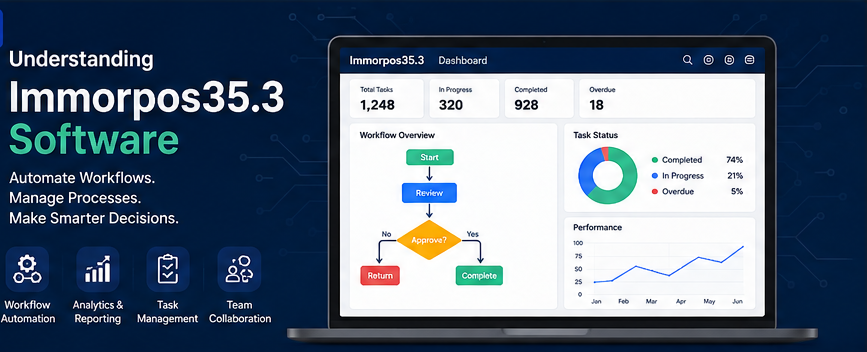
Immorpos35.3 is described as a business process automation and management platform designed to help organizations organize repetitive tasks, manage workflows, and understand operational data more efficiently.
For growing businesses, managing daily operations can become difficult. Teams may rely on spreadsheets, emails, manual approvals, and separate software tools. As the amount of work increases, these methods can lead to missed tasks, slow approvals, duplicated work, and difficulty tracking important information.
The idea behind a platform such as Immorpos35.3 is to bring these processes into a more organized environment.
Instead of employees manually checking every task or collecting information from different systems, automated workflows can help move routine work from one step to another.
Read Our Guide On:
Key Takeaways
- Immorpos35.3 is described as a business workflow and automation platform.
- Its main purpose is to help organize repetitive business processes and operational information.
- Automation can reduce manual work and make routine tasks easier to manage.
- Analytics can help teams understand workflow performance and identify areas that need improvement.
- Businesses should organize and standardize their processes before automating them.
- Clean and consistent data is important when connecting different business systems.
- Immorpos35.3 should not automatically be considered a replacement for a complete ERP system.
- The actual features available can depend on the specific version and implementation.
What Is Immorpos35.3 Software?
Immorpos35.3 software can be understood as a tool for business workflow management and process automation.
The basic idea is simple: businesses have many tasks that need to happen repeatedly.
For example, a company might have a process like this:
Customer request → employee review → manager approval → task completion → report
When this process is handled manually, employees may need to send emails, update spreadsheets, remind other team members, and prepare reports.
A workflow automation platform can help organize these steps into a structured process.
Instead of depending entirely on employees to remember what happens next, predefined rules can determine how a task moves through the workflow.
This can make daily operations more consistent and easier to monitor.
Why Do Businesses Need Workflow Automation?
Many small and medium-sized businesses start with simple tools such as spreadsheets, email, and messaging applications.
These tools can work well when a company is small.
However, as the business grows, the number of customers, employees, projects, and tasks also increases.
This can create several problems.
Missed Tasks
Employees may forget to complete a task or follow up with someone.
Slow Approvals
A request can remain stuck because the person responsible for approving it has not seen the message.
Repetitive Work
Employees may spend hours performing the same manual actions every week.
Scattered Information
Important information may be spread across spreadsheets, emails, documents, and different applications.
Difficult Reporting
Managers may need to collect information from several sources before they can understand what is happening.
Workflow automation aims to reduce these problems by creating a more structured process.
What Does Immorpos35.3 Do?
The main concept behind Immorpos35.3 is to connect workflow automation with operational data and analytics.
Instead of treating every task as an isolated activity, the platform can organize processes into a sequence of actions.
A typical workflow might include:
- A task or request is created.
- The system identifies the next step.
- The task is assigned to the appropriate person.
- An approval or action is requested.
- The result is recorded.
- The workflow moves to the next stage.
- Information can be used for reporting and analysis.
The exact functions available depend on the particular version and configuration of the software.
How Workflow Automation Works
Workflow automation is easier to understand when you think about simple if-then rules.
For example:
If a customer submits a request,
then create a task for the support team.
Another example could be:
If an employee completes a required form,
then send the information to the person responsible for the next approval.
This approach removes some of the manual work involved in moving information between people and departments.
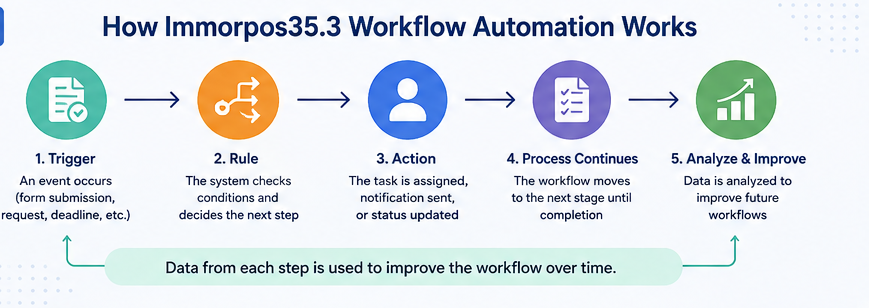
Trigger
A workflow usually starts with an event.
A trigger could be something such as:
- A form submission
- A new request
- A completed task
- A deadline
- A status change
- An approval request
Rule
The system then checks the conditions that have been defined.
For example, a particular type of request may need manager approval while another request may not.
Action
Once the conditions are met, the system performs the next action.
This might involve:
- Assigning a task
- Sending a notification
- Updating a status
- Moving information to another step
- Creating a report
This basic structure is what makes workflow automation useful for repetitive business processes.
IBM Business Automation Workflow
How Analytics Can Help
Automation is only one part of managing business operations.
Businesses also need to understand how their processes are performing.
Analytics can help answer questions such as:
- How many tasks are completed each week?
- Which processes take the longest?
- Where are tasks getting delayed?
- Which workflows require the most manual work?
- Are approval processes slowing down projects?
- Are employees spending too much time on repetitive activities?
Instead of looking through individual spreadsheets or emails, managers can use organized data to identify patterns.
This can make decision-making easier.
Automation and Analytics Work Better Together
One important advantage of connecting workflow information with analytics is that the two functions can support each other.
The workflow system produces operational data.
That data can then be analyzed to understand how the process is performing.
For example, imagine that a business discovers that customer requests regularly remain unassigned for several hours.
The company can investigate why this happens.
Perhaps the requests are being sent to a busy employee. Perhaps the approval process contains an unnecessary step.
After identifying the problem, the workflow can be changed.
This creates a simple improvement cycle:
Run the workflow → collect data → analyze the results → identify problems → improve the workflow
The goal is not simply to automate everything.
The goal is to make business processes more efficient.
Who Can Benefit From Immorpos35.3?
Immorpos35.3 may be most useful for organizations that have reached a point where manual processes are becoming difficult to manage.
This can include businesses that are experiencing:
- Increasing numbers of repetitive tasks
- Manual approval processes
- Multiple departments handling the same workflow
- Too many spreadsheets
- Slow reporting
- Difficulty tracking tasks
- Problems with communication between teams
Small and Medium-Sized Businesses
Growing businesses often need more structure but may not need a large enterprise platform.
A workflow automation solution can provide a middle ground between simple spreadsheets and highly complex enterprise systems.
Operations Teams
Operations departments frequently manage processes that involve multiple employees and repeated steps.
Automation can help make these processes more consistent.
Customer Support Teams
Customer requests can follow predictable workflows.
For example:
Request received → assigned → reviewed → resolved → closed
Automating parts of this process can help reduce delays.
Human Resources Teams
HR departments often handle repetitive processes such as employee onboarding, document collection, approvals, and internal requests.
Automation can help organize these workflows.
Is Immorpos35.3 an ERP System?
Immorpos35.3 should not automatically be treated as a replacement for a full ERP system.
An ERP, or Enterprise Resource Planning system, normally covers broad business functions such as:
- Accounting
- Finance
- Inventory
- Procurement
- Human resources
- Supply chain management
- Business reporting
A workflow automation platform has a narrower focus.
It is generally used to organize and automate particular business processes rather than replace every major business system.
For this reason, businesses should first identify the problem they are trying to solve before deciding whether a workflow platform or ERP system is appropriate.
Common Ways Businesses Can Use Workflow Automation
The best use case depends on the organization’s needs.
Here are several common examples.
Employee Onboarding
A new employee may need to complete several steps.
For example:
- HR creates the employee record.
- Documents are collected.
- IT receives an account request.
- Equipment is assigned.
- The manager receives a notification.
- The onboarding process is completed.
A workflow can help ensure that each step is not forgotten.
Customer Follow-Ups
Businesses can create processes for customer communication.
For example, after a request is completed, the system can move the customer to a follow-up stage.
Approval Processes
A company may require approval before purchasing equipment, launching a project, or processing a request.
A workflow can route the request to the appropriate person.
Internal Requests
Employees may regularly submit requests to different departments.
A structured workflow can help route those requests to the correct team.
Reporting
Instead of manually collecting information from multiple sources, businesses can organize operational information for easier reporting.
Why Immorpos35.3 Implementations Can Fail
Buying or installing automation software does not automatically improve a business.
The biggest problems often come from the processes being automated.
If the existing process is confusing, inconsistent, or poorly documented, automation can simply make the problem happen faster.
There are several common reasons why implementations fail.
Automating a Poorly Organized Process
Imagine five employees completing the same task in five different ways.
If that process is automated without first creating a standard method, the software may struggle to produce consistent results.
The Better Approach
First document the current process.
Then:
- Identify unnecessary steps.
- Remove duplicate work.
- Decide who is responsible for each stage.
- Create a standard process.
- Test it manually.
- Automate the stable process.
This approach gives automation a much stronger foundation.
Poor Data Quality
Automation depends heavily on accurate information.
If customer records contain missing information or different departments use different formats, connecting systems will not automatically solve the problem.
For example, one system might store a customer’s full name in one field while another separates the first and last names.
These differences can create problems when information moves between systems.
The Better Approach
Before connecting different tools:
- Review existing data.
- Remove duplicates.
- Standardize important fields.
- Identify missing information.
- Decide which system is the main source of truth.
- Test the data connection.
Good automation requires good data.
Lack of Employee Training
Even a well-designed system can fail if employees do not understand how to use it.
Employees should know:
- Why the new system is being introduced.
- What their responsibilities are.
- How tasks move through the workflow.
- What to do when something goes wrong.
- Where to find help.
Training does not need to be complicated.
Short demonstrations and simple documentation can make adoption much easier.
Trying to Automate Everything
Not every business process needs automation.
Some tasks require human judgment, creativity, or personal communication.
Automating these tasks may create more problems than it solves.
A better strategy is to start with repetitive and predictable processes.
For example:
Good automation candidate:
Sending a notification when a task reaches a particular status.
Possible poor automation candidate:
Making a complex decision that requires expert judgment.
The goal should be useful automation, not maximum automation.
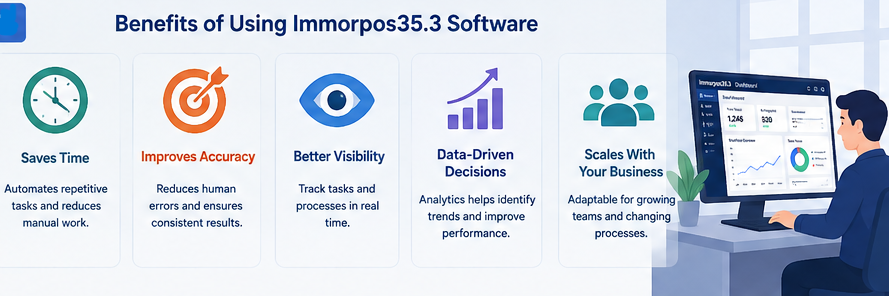
Benefits of Using Workflow Automation
When implemented correctly, workflow automation can provide several benefits.
Saves Time
Employees spend less time performing repetitive administrative tasks.
Reduces Manual Errors
Automated steps can reduce mistakes caused by forgetting or manually entering information.
Improves Visibility
Managers can get a clearer picture of where tasks are in a process.
Creates Consistent Workflows
Employees can follow the same process instead of creating their own methods.
Makes Reporting Easier
Structured operational data can make it easier to understand business performance.
Helps Businesses Scale
A standardized workflow can make it easier to handle additional work without increasing manual effort at the same rate.
Things to Consider Before Using Immorpos35.3
Before adopting any business automation platform, consider several important factors.
Identify Your Main Problem
Do not start with the software.
Start with the problem.
Ask:
What process is currently wasting the most time?
This gives you a clear starting point.
Check Integration Requirements
If your business already uses other applications, determine whether they can work together with the platform.
Integration requirements should be understood before implementation.
Consider Data Security
Business systems may handle sensitive information.
Before using new software, review:
- Security practices
- Access controls
- Data storage
- User permissions
- Backup procedures
- Privacy documentation
Calculate the Total Cost
The cost of a software solution may include more than the initial license.
Consider:
- Software costs
- Implementation
- Training
- Integration
- Maintenance
- Support
- Additional users
A solution should provide enough value to justify its total cost.
How to Get Better Results From Immorpos35.3
If you decide to use Immorpos35.3, start small.
Choose one process that is repetitive and easy to measure.
For example, you could begin with an internal approval workflow.
Measure the process before automation.
Then compare the results after implementation.
Useful measurements can include:
- Average completion time
- Number of delayed tasks
- Number of manual steps
- Number of errors
- Employee time spent on the process
This gives you a practical way to determine whether automation is actually helping.
Read Our Guide On:
Why GenBoostermark Software Is So Popular
Frequently Asked Questions
What is Immorpos35.3 software?
Immorpos35.3 is described as a business process automation and management platform. It is intended to help organizations organize workflows, automate repetitive tasks, and work with operational information more efficiently.
What can Immorpos35.3 be used for?
Depending on the implementation, a workflow automation platform can be used for processes such as task routing, approvals, employee onboarding, customer follow-ups, internal requests, and operational reporting.
Is Immorpos35.3 an ERP?
Not necessarily. Workflow automation and ERP systems serve different purposes. An ERP generally manages broad business functions such as finance, inventory, HR, and procurement, while workflow software focuses more heavily on specific operational processes.
Is Immorpos35.3 suitable for small businesses?
It may be useful for small and medium-sized businesses that have outgrown spreadsheets and manual processes. However, businesses should evaluate their specific requirements before choosing any software platform.
Does workflow automation eliminate employees?
No. Automation is generally intended to reduce repetitive manual work rather than eliminate the need for employees. People are still needed for decision-making, problem-solving, communication, and tasks that require judgment.
Why is data quality important for automation?
Automation depends on the information moving through the system. If data is incomplete, duplicated, or inconsistent, automated workflows may produce unreliable results. Cleaning and standardizing data before implementation can reduce these problems.
How long does it take to implement Immorpos35.3?
Implementation time depends on the complexity of the organization’s workflows, integrations, data, and training requirements. A simple workflow may be configured relatively quickly, while a larger implementation can require considerably more planning and testing.
What is the best way to start using workflow automation?
Start with one repetitive and well-defined process. Document how the process currently works, remove unnecessary steps, establish clear responsibilities, and then automate the stable workflow.
Why do business automation projects fail?
Common causes include poorly defined workflows, inaccurate data, insufficient employee training, weak planning, and trying to automate too many processes at once.
Read Our Guide On:
Grammarly Alternatives: 10 Best Options
Conclusion
Immorpos35.3 software is designed around the idea of making business operations more organized through workflow automation and better management of operational information. Instead of relying on spreadsheets, emails, and repetitive manual tasks, businesses can use structured workflows to keep everyday processes moving.
However, getting good results depends on more than simply installing the software. Businesses should first understand their existing processes, remove unnecessary steps, organize their data, and make sure employees know how the system works.
For the best results, start with one simple and repetitive process, test the workflow, and measure the improvement. If the process becomes faster, more consistent, and easier to manage, additional workflows can be automated over time.
In short, Immorpos35.3 can be useful for businesses looking to improve workflow management and reduce manual work, but its value depends on how well it fits the organization’s specific needs and how carefully it is implemented.
Read Our Guide On:
How HCS 411GITS Software Built

Mehtab Hassan is the founder and tech writer at Brozly, where he publishes easy-to-understand articles on AI, software, cybersecurity, smartphones, laptops, and emerging technology. His goal is to help readers make smarter tech decisions through detailed reviews, practical tutorials, and beginner-friendly guides. He is passionate about exploring the latest innovations and delivering accurate, up-to-date content that everyone can understand.