If you have searched for how HCS 411GITS software is built, you may have noticed something important. However, there is no clear, official explanation available online. Different websites describe HCS 411GITS in different ways, and some provide technical details without linking to reliable sources.
Because of this, it is important to separate verified information from assumptions.
There does not seem to be an official technical document that confirms the exact architecture, programming languages, database, development team, or technology stack used to build HCS 411GITS. Some websites describe it as an enterprise, workflow, data, logistics, or intelligent transportation system, but these descriptions are not consistent.
For this reason, this guide explains what is publicly known about HCS 411GITS. However, when specific technical details cannot be verified, we explain how a complex software system like this would normally be designed and developed.
Read Our Guide On:
Key Takeaways
- The exact technical architecture of HCS 411GITS is not publicly verified by a reliable primary source.
- Building complex software normally starts with requirements, planning, and system architecture.
- Developers typically divide large applications into manageable modules.
- Databases, APIs, authentication, testing, monitoring, and deployment are important parts of modern software development.
- Version control helps developers safely manage changes and collaborate.
- Security should be considered throughout development rather than added only after launch.
- Testing and continuous maintenance are essential for keeping software reliable.
- Claims about specific HCS 411GITS technologies should not be treated as fact unless supported by official documentation.
What Is HCS 411GITS Software?
The first challenge with this keyword is determining exactly what HCS 411GITS refers to.
Search results show multiple explanations, but there is no consistently cited official source that provides a definitive product description. Some websites describe HCS 411GITS as a sophisticated software platform involving workflows, data processing, automation, dashboards, and integrations. Others associate the term with transportation or enterprise systems.
Because these descriptions conflict, it would be misleading to claim that one particular definition is confirmed.
The safest conclusion is that HCS 411GITS is a poorly documented or ambiguously referenced software term online.
This distinction matters because several websites publish very specific claims about its programming languages, cloud infrastructure, databases, and security technologies without providing primary evidence.
For example, some pages claim technologies such as React, Node.js, PostgreSQL, Redis, Docker, AWS, and JWT were used. However, these technologies should be considered examples or unverified claims, not confirmed details about HCS 411GITS.
Why Is It Difficult to Know How HCS 411GITS Was Built?
There are several reasons the question is difficult to answer with complete certainty.
Limited Official Documentation
A well-documented commercial software product normally has some combination of:
- An official website
- Developer documentation
- Product documentation
- Release notes
- Technical manuals
- Git repositories
- Vendor information
- User communities
- API documentation
For HCS 411GITS, publicly available search results do not provide enough authoritative information to establish its exact internal implementation.
Conflicting Online Descriptions
Another problem is that different websites describe the software differently.
One source may discuss enterprise workflows, while another describes transportation or data-management functionality. Some articles also present hypothetical architecture as if it were confirmed.
This makes it difficult to identify which technical claims are genuine.
SEO Content Can Create Confusion
The keyword has also appeared across numerous websites publishing articles with very similar titles and structures.
Some pages provide detailed explanations without citing an official manufacturer or developer. Others make highly specific technical claims that cannot easily be verified.
For readers, the important lesson is simple: a detailed article does not automatically mean the information is verified.
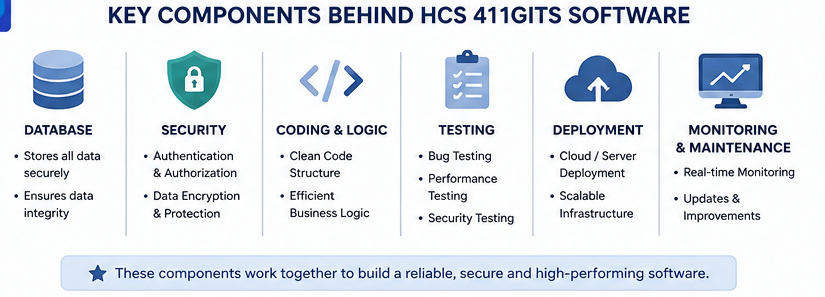
How HCS 411GITS Software Would Typically Be Built
Although the exact HCS 411GITS development process is not publicly documented, we can explain how a complex software system of this type would normally be built.
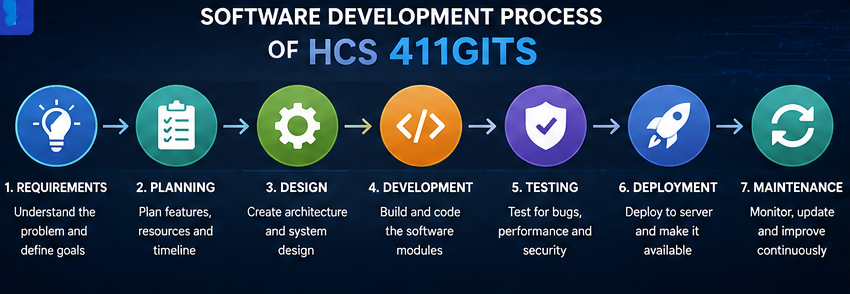
The process generally follows several major stages:
- Requirement analysis
- System planning
- Architecture design
- Database design
- User-interface development
- Backend development
- API integration
- Security implementation
- Testing
- Deployment
- Monitoring and maintenance
Let’s examine these stages in simple terms.
1. Requirement Analysis Comes First
Software development does not normally begin with writing code.
The development team first needs to understand the problem the software is supposed to solve.
This stage may involve discussions with:
- Business owners
- Managers
- Developers
- System administrators
- End users
- Security specialists
- Technical stakeholders
The team identifies what the software needs to accomplish and documents the requirements.
For example, a complex platform might need to:
- Store information
- Process user requests
- Generate reports
- Manage different user roles
- Connect with external systems
- Automate repetitive tasks
- Track system activity
Clear requirements provide the foundation for the rest of the project.
2. System Architecture Is Designed
After requirements have been established, developers create the software architecture.
Think of architecture as the blueprint of the software.
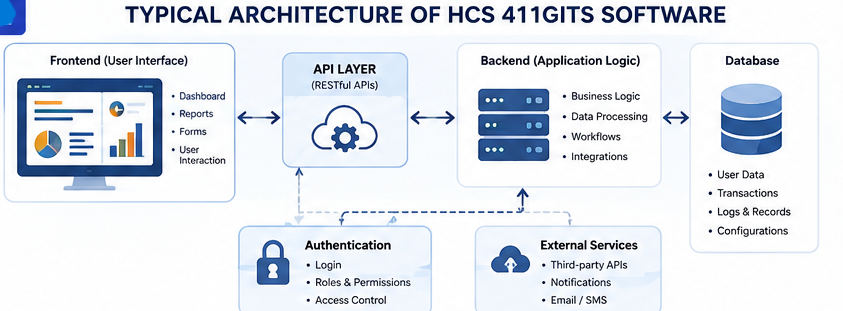
A complex application may contain several layers:
| Layer | Purpose |
|---|---|
| Frontend | Provides the user interface |
| Backend | Handles application logic |
| Database | Stores information |
| API layer | Connects different systems |
| Authentication | Controls user access |
| Monitoring | Tracks system health |
This type of separation makes the system easier to develop, test, maintain, and update.
Importantly, this is a general architecture model, not a confirmed diagram of HCS 411GITS.
3. The Software Is Divided Into Modules
Large software systems are usually easier to manage when functionality is divided into smaller modules.
For example, a hypothetical system could contain modules for:
- User management
- Data processing
- Reporting
- Notifications
- Authentication
- Configuration
- Administration
- External integrations
Each module can have a specific responsibility.
This approach is called modular architecture.
The advantage is that developers can modify one part of the application without necessarily changing the entire system.
Several online descriptions of HCS 411GITS emphasize modularity, but the exact internal module structure has not been independently verified.
4. Database Design
Most software applications need a reliable way to store information.
Developers therefore design a database based on the application’s requirements.
A database may store information such as:
- User accounts
- Configuration settings
- Transactions
- System records
- Reports
- Activity logs
- Application data
The database structure must be designed carefully.
Poor database design can result in:
- Slow queries
- Duplicate information
- Data inconsistencies
- Difficult maintenance
- Performance problems
The actual database technology used by HCS 411GITS has not been publicly confirmed.
Some online articles mention PostgreSQL and other database technologies, but those claims should be treated cautiously unless supported by primary documentation.
5. Frontend Development
The frontend is the part of software users interact with.
It can include:
- Dashboards
- Forms
- Menus
- Tables
- Reports
- Search features
- Settings pages
- Notifications
A good interface should make complicated functions easy to understand.
For business and enterprise software, usability is especially important because users may interact with the system for hours every day.
The frontend normally communicates with the backend through APIs.
6. Backend Development
The backend handles the application’s core logic.
For example, when a user submits information through a dashboard, the backend may:
- Receive the request.
- Verify the user.
- Validate the submitted data.
- Apply business rules.
- Communicate with the database.
- Process the result.
- Send a response to the frontend.
This separation allows the user interface and internal processing systems to evolve independently.
The specific programming language or backend framework used to build HCS 411GITS is not publicly established.
Therefore, claims that it definitely uses Node.js, Python, Java, C#, or another language should not be presented as confirmed facts.
7. APIs Connect Different Systems
Modern software rarely operates completely by itself.
APIs, or Application Programming Interfaces, allow different software components to communicate.
For example, an API could allow one application to:
- Send information
- Retrieve records
- Authenticate users
- Request reports
- Update information
- Communicate with an external service
If HCS 411GITS is a complex integrated system as some online sources suggest, APIs would be a logical architectural component.
However, the exact APIs used by the software cannot be confirmed from reliable public documentation.
8. Security Is Built Into the Development Process
Security is another major part of software development.
A complex application may need protection against:
- Unauthorized access
- Weak authentication
- Data leaks
- Injection attacks
- Malicious requests
- Account abuse
- Incorrect permissions
Developers can implement security controls such as:
- Authentication
- Authorization
- Secure password storage
- Encryption
- Input validation
- Access controls
- Logging
- Security testing
Security should not be treated as something that is added only after the application has been completed.
Instead, it should be considered throughout the development lifecycle.
9. Testing Happens Before Release
Writing code does not mean the software is finished.
Developers need to test whether the application actually works as expected.
Common testing approaches include:
Unit Testing
Tests individual functions or components.
Integration Testing
Checks whether different parts of the application work together.
System Testing
Tests the complete application.
Security Testing
Looks for vulnerabilities and weaknesses.
Performance Testing
Measures how the system behaves under different workloads.
User Acceptance Testing
Allows real users or stakeholders to verify that the software meets requirements.
Testing helps identify problems before they affect users.
10. Version Control Helps Manage Development
Complex software projects usually involve many changes.
Developers need a way to track those changes and collaborate safely.
Version-control systems such as Git allow teams to:
- Track code changes
- Create branches
- Review modifications
- Merge new features
- Restore previous versions
- Collaborate with other developers
Git’s branching model is particularly useful when several developers are working on different features at the same time.
However, the presence of the word “GITS” in the keyword should not automatically be interpreted as proof that HCS 411GITS uses Git or GitHub.
That would be an assumption rather than verified information.
11. Deployment Makes the Software Available
After development and testing, the software needs to be deployed.
Depending on the application, deployment could involve:
- Servers
- Cloud infrastructure
- Databases
- Containers
- Network configuration
- Security controls
- Backup systems
- Monitoring tools
Before a production release, developers typically verify that the environment is configured correctly.
Some online articles associate HCS 411GITS with cloud technologies and containers, but these specific claims are not independently confirmed by authoritative HCS 411GITS documentation.
12. Maintenance Continues After Launch
Software development does not end when the application is released.
After deployment, developers may need to:
- Fix bugs
- Improve performance
- Patch security vulnerabilities
- Add new features
- Update dependencies
- Improve usability
- Monitor system health
- Respond to user feedback
This is why maintainability is an important part of software architecture.
A well-designed system should make future updates easier rather than requiring developers to rebuild everything from scratch.
What Technology Stack Does HCS 411GITS Use?
There is currently no reliable public evidence that conclusively identifies the complete technology stack of HCS 411GITS.
Some online articles claim that the software uses combinations such as:
- React
- TypeScript
- Node.js
- PostgreSQL
- Redis
- Docker
- AWS
- GitHub
- JWT
But these claims appear in secondary articles rather than clearly documented official technical sources.
Therefore, it is better to describe these technologies as possible examples used by similar modern applications, not as confirmed HCS 411GITS technologies.
This distinction is important for accurate technical writing.
Why a Modular Design Would Be Useful
If HCS 411GITS is a complex software platform, modularity would provide several advantages.
Easier Maintenance
Developers can update individual components without modifying the entire application.
Better Scalability
Individual services or modules can potentially be expanded when demand increases.
Easier Testing
Smaller components can be tested independently.
Faster Development
Different developers can work on different parts of the system.
Easier Troubleshooting
When something fails, developers can investigate the relevant component rather than the entire application.
These are general benefits of modular software architecture rather than confirmed characteristics of HCS 411GITS.
Common Challenges When Building Complex Software
Developing sophisticated software is not easy.
Some common challenges include:
Managing Complexity
As the number of features grows, the architecture becomes more complicated.
Maintaining Performance
Large amounts of data can create database and processing bottlenecks.
Protecting Data
Applications must prevent unauthorized users from accessing sensitive information.
Integrating External Systems
Different systems may use different data formats, APIs, and authentication methods.
Supporting Future Updates
Developers need to avoid creating architecture that becomes difficult to maintain.
Testing at Scale
A system may work perfectly with a small amount of data but behave differently under heavy workloads.
Good architecture and continuous testing help address these problems.
How HCS 411GITS-Type Software Could Be Improved
If a complex system needs improvement, developers can focus on several areas.
Improve Performance
Slow database queries, inefficient code, and unnecessary processing can be optimized.
Strengthen Security
Security reviews, dependency updates, access controls, and vulnerability testing can reduce risk.
Improve the User Interface
Simpler navigation and clearer workflows can make software easier to use.
Improve Documentation
Technical documentation helps developers understand how the system works.
User documentation helps customers understand how to use it.
Automate Testing and Deployment
Automated testing and controlled deployment processes can reduce human error and speed up development.
What We Can and Cannot Confirm About HCS 411GITS
This is perhaps the most important part of understanding the keyword.
What Can Be Reasonably Said
Public discussions associate HCS 411GITS with software development concepts such as:
- Modular architecture
- Data handling
- Workflow management
- Integration
- Testing
- Deployment
- Maintenance
These themes appear repeatedly across secondary sources.
What Cannot Be Reliably Confirmed
There is not enough authoritative public documentation to confidently state:
- The original developer
- The exact development team
- The official programming language
- The exact database
- The confirmed cloud provider
- The exact architecture
- The official Git repository
- The precise security implementation
- The complete technology stack
This is why responsible technical content should avoid presenting speculation as fact.
Read Our Guide On:
How to Use Immorpos35.3 Software: Features, Uses, & Benefits
Why Understanding Software Development Matters
Even if you are not a developer, understanding how complex software is created can be useful.
It helps you understand why software products require:
- Planning
- Development
- Testing
- Security
- Documentation
- Updates
- Maintenance
It also helps users evaluate technical claims more critically.
When an article claims that a particular application uses a specific framework or database, you should ask whether the claim comes from an official technical source or simply another website repeating the same information.
Read Our Guide On:
Grammarly Alternatives: 10 Best Options
Frequently Asked Questions
What is HCS 411GITS software?
HCS 411GITS is a poorly documented software term online. Different websites describe it differently, and there is currently no clear authoritative public documentation establishing one definitive description.
How is HCS 411GITS software built?
The exact development process has not been publicly verified. A complex system of this type would normally involve requirements analysis, architecture design, coding, database development, testing, deployment, security, and ongoing maintenance.
What programming language does HCS 411GITS use?
There is no reliable public source confirming the exact programming language used by HCS 411GITS. Claims about specific languages should therefore be treated cautiously.
Does HCS 411GITS use Git or GitHub?
The name alone does not prove that the software uses Git or GitHub. Some secondary articles make this connection, but it is not enough to establish it as an official fact.
Is HCS 411GITS cloud-based?
Some online descriptions associate the term with cloud and modern infrastructure, but the exact deployment environment has not been reliably confirmed through primary documentation.
Why is information about HCS 411GITS difficult to find?
The term has limited authoritative documentation and appears in multiple inconsistent online descriptions. This makes it difficult to distinguish confirmed information from assumptions.
Can beginners understand how software like HCS 411GITS is built?
Yes. The basic process can be understood without programming knowledge: define the problem, design the system, build its components, connect them, test everything, deploy it, and continue maintaining it.
Read Our Guide On:
What Is Productivity Software and Its Benefits
Conclusion
Understanding how HCS 411GITS software built is difficult because the term does not currently have a clearly documented technical specification from an authoritative public source.
Many websites provide detailed explanations, but their descriptions do not always agree. Some also make specific claims about programming languages, databases, cloud platforms, or architecture without providing primary evidence.
The most reliable approach is therefore to separate confirmed information from general software-engineering practices.
A complex application would typically be created through a structured process that includes requirements gathering, architecture planning, modular development, database design, API integration, security, testing, deployment, monitoring, and continuous maintenance.
The exact internal technology stack of HCS 411GITS remains unclear from publicly available evidence. Until official technical documentation becomes available, specific claims about its architecture should be treated as unverified.
Read Our Guide On:
Why GenBoostermark Software Is So Popular in 2026

Mehtab Hassan is the founder and tech writer at Brozly, where he publishes easy-to-understand articles on AI, software, cybersecurity, smartphones, laptops, and emerging technology. His goal is to help readers make smarter tech decisions through detailed reviews, practical tutorials, and beginner-friendly guides. He is passionate about exploring the latest innovations and delivering accurate, up-to-date content that everyone can understand.