
Productivity software has become an essential part of modern work and daily life. Whether you’re a student, freelancer, business owner, or office employee, productivity software helps you organize tasks, manage time, collaborate with others, and complete work more efficiently.
From writing documents and managing projects to scheduling meetings and automating repetitive tasks, productivity software makes it easier to stay focused and achieve more in less time.
In this guide, you’ll learn what productivity software is, how it works, its benefits, different types, popular examples, and how to choose the right software for your needs.
What Is Productivity Software?
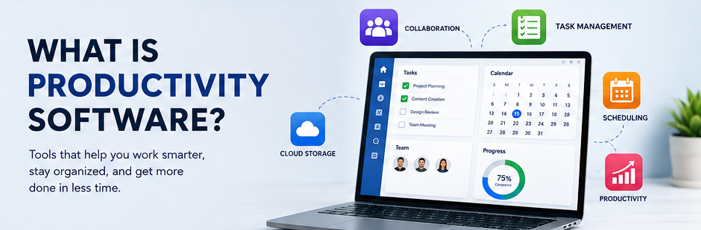
Productivity software is a type of computer or mobile application designed to help people complete tasks more efficiently. It improves organization, communication, planning, collaboration, and workflow management, allowing users to save time and increase productivity.
Instead of doing everything manually, productivity software provides tools that simplify everyday work. These tools can help create documents, manage projects, organize schedules, take notes, track progress, communicate with teams, and even automate repetitive tasks.
Whether you’re writing an assignment, managing a business project, or planning your daily schedule, productivity software helps you work smarter instead of harder.
Why Is Productivity Software Important?
Today’s work environment is faster than ever. People often manage multiple tasks, deadlines, meetings, and projects simultaneously. Without proper organization, it’s easy to lose track of important work.
Productivity software helps solve these challenges by making work more structured and organized.
Some major benefits include:
- Saves valuable time
- Improves organization
- Reduces manual work
- Increases team collaboration
- Helps manage deadlines
- Keeps information organized
- Improves communication
- Reduces human error
- Supports remote work
- Boosts overall efficiency
Instead of switching between paper notes, spreadsheets, emails, and calendars, productivity software brings everything together in one place.
How Does Productivity Software Work?
Productivity software works by providing digital tools that help users organize information, manage tasks, communicate, and automate workflows.
For example:
- A task manager reminds you about deadlines.
- A document editor lets multiple people edit files together.
- A calendar schedules meetings automatically.
- A note-taking app organizes research.
- AI-powered software summarizes meetings and generates reports.
These features eliminate repetitive work and help users focus on more important tasks.
Main Features of Productivity Software
Although different applications serve different purposes, most productivity software includes several common features.
Task Management
Task management tools help users create to-do lists, assign priorities, track deadlines, and monitor progress.
Features often include:
- Task lists
- Due dates
- Priority levels
- Progress tracking
- Reminders
- Notifications
Document Creation
Most productivity software allows users to create and edit documents.
Common document types include:
- Reports
- Letters
- Assignments
- Spreadsheets
- Presentations
- PDFs
Many modern applications also support real-time collaboration.
Calendar and Scheduling
Scheduling tools help users organize meetings, appointments, and daily activities.
Benefits include:
- Calendar management
- Meeting reminders
- Event scheduling
- Time blocking
- Appointment tracking
Team Collaboration
Modern workplaces rely heavily on collaboration.
Productivity software often includes:
- Shared workspaces
- File sharing
- Team messaging
- Video meetings
- Comments
- Project updates
This allows team members to work together regardless of location.
Cloud Storage
Cloud-based productivity software stores files online instead of only on your computer.
Advantages include:
- Access files anywhere
- Automatic backups
- Easy sharing
- Secure storage
- Cross-device synchronization
AI-Powered Assistance
Many modern productivity applications now include artificial intelligence.
AI features may include:
- Writing assistance
- Email drafting
- Meeting summaries
- Task suggestions
- Grammar correction
- Workflow automation
- Content generation
- Data analysis
AI helps users complete routine tasks much faster.
Types of Productivity Software
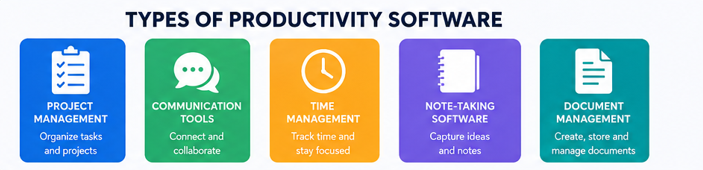
There are many different categories of productivity software. Each serves a specific purpose.
1. Office Productivity Software
Office software helps users create professional documents.
Examples include:
- Word processing
- Spreadsheets
- Presentation software
- PDF editing
Best for:
- Students
- Businesses
- Teachers
- Office workers
2. Project Management Software
Project management software helps organize projects from start to finish.
Features include:
- Task assignment
- Project timelines
- Team collaboration
- Progress tracking
- Deadline management
Best for:
- Businesses
- Agencies
- Remote teams
- Freelancers
3. Note-Taking Software
These applications help users capture ideas and organize information.
Common uses:
- Lecture notes
- Meeting notes
- Personal journals
- Research
- Checklists
4. Communication Software
Communication software allows teams to stay connected.
Examples include:
- Team chat
- Video conferencing
- Voice calls
- File sharing
These tools are especially useful for remote work.
5. Time Management Software
Time management applications help users use their time more effectively.
Features include:
- Timers
- Productivity tracking
- Daily schedules
- Focus sessions
- Time reports
6. AI Productivity Software
AI-powered software is becoming one of the fastest-growing categories.
It can assist with:
- Writing
- Research
- Coding
- Note summaries
- Email replies
- Brainstorming
- Scheduling
These tools save hours of manual work.
Benefits of Productivity Software

Using productivity S/W offers many advantages for individuals and organizations.
Better Organization
Everything stays organized in one place.
You can easily find:
- Documents
- Notes
- Tasks
- Projects
- Files
Increased Productivity
Automation removes repetitive work.
Instead of spending time on routine tasks, users can focus on more valuable work.
Better Collaboration
Multiple people can work together simultaneously without confusion.
This improves teamwork and communication.
Improved Time Management
Productivity S/W helps users:
- Plan work
- Set deadlines
- Prioritize tasks
- Reduce procrastination
Higher Accuracy
Automation reduces mistakes.
Examples include:
- Grammar checking
- Automatic calculations
- File version control
- Task reminders
Who Uses Productivity Software?
Almost everyone can benefit from productivity S/W.
Students
Students use it for:
- Homework
- Assignments
- Note-taking
- Research
- Revision planning
Freelancers
Freelancers use productivity software to:
- Manage clients
- Track projects
- Send invoices
- Organize deadlines
Businesses
Companies use it for:
- Team collaboration
- Project management
- Communication
- Workflow automation
Content Creators
Creators use productivity S/W for:
- Content planning
- Video scripts
- Research
- Social media scheduling
Remote Workers
Remote teams rely heavily on productivity S/W for communication and collaboration.
Popular Examples of Productivity Software
Some of the most widely used productivity software includes:
Each application focuses on different aspects of productivity.
How AI Is Changing Productivity Software
Artificial intelligence is transforming productivity S/W faster than ever.
AI can now:
- Write documents
- Summarize meetings
- Create presentations
- Organize tasks
- Suggest schedules
- Analyze data
- Improve emails
- Generate reports
Instead of replacing people, AI acts as a digital assistant that speeds up everyday work.
How to Choose the Best Productivity Software
When selecting productivity software, consider the following factors.
Ease of Use
Choose software with a clean interface and simple navigation.
Features
Select software that matches your needs.
For example:
- Task management
- Note-taking
- Collaboration
- AI assistance
Compatibility
Make sure it works on:
- Windows
- Mac
- Android
- iPhone
- Web browser
Pricing
Many productivity applications offer free plans.
Upgrade only if premium features are necessary.
Security
Choose software that protects your personal information and business data.
Common Mistakes to Avoid
Many users reduce their productivity by making common mistakes.
Avoid:
- Installing too many productivity apps
- Ignoring notifications
- Not organizing files
- Skipping backups
- Failing to update software
- Using complicated workflows
Simple systems usually work best.
Future of Productivity Software
The future of productivity S/W will be driven by artificial intelligence.
Future tools will likely include:
- Smarter automation
- Better voice assistants
- Personalized workflows
- AI project management
- Predictive scheduling
- Advanced collaboration
- Intelligent document creation
These innovations will continue making work faster and more efficient.
What Is CRM Software? Complete Guide (2026)
Conclusion
Productivity S/W helps people organize work, manage time, collaborate with teams, and complete tasks more efficiently whether you’re a student, professional, freelancer, or business owner, the right productivity S/W can save time, reduce stress, and improve your workflow.
With the rapid growth of artificial intelligence, productivity S/W is becoming even more powerful. AI-powered features can automate repetitive work, improve communication, and help users focus on high-value tasks.
The key is choosing software that fits your needs instead of using every available tool. Start with one or two applications, learn them well, and gradually build a productivity system that works for you.
Frequently Asked Questions
1. What is productivity software?
Productivity software is a digital application that helps users complete tasks more efficiently by improving organization, communication, planning, collaboration, and workflow management.
2. What are examples of productivity software?
Popular examples include Microsoft 365, Google Workspace, Notion, Trello, Asana, Slack, ClickUp, Todoist, Evernote, and Monday.com.
3. What are the benefits of productivity software?
It helps users save time, improve organization, collaborate with teams, automate repetitive tasks, manage projects, and increase overall productivity.
4. Is productivity software only for businesses?
No. Students, freelancers, teachers, remote workers, content creators, and individuals can all benefit from productivity software.
5. Can AI improve productivity software?
Yes. AI-powered productivity software can automate routine tasks, generate content, summarize meetings, improve writing, organize schedules, and help users work more efficiently.
6. Is productivity software free?
Many productivity software applications offer free versions with basic features. Premium plans usually include advanced collaboration, storage, and AI capabilities.
7. How do I choose the right productivity software?
Choose software based on your needs, budget, ease of use, device compatibility, security, and the features that will help improve your daily workflow.

Mehtab Hassan is the founder and tech writer at Brozly, where he publishes easy-to-understand articles on AI, software, cybersecurity, smartphones, laptops, and emerging technology. His goal is to help readers make smarter tech decisions through detailed reviews, practical tutorials, and beginner-friendly guides. He is passionate about exploring the latest innovations and delivering accurate, up-to-date content that everyone can understand.