What Is an SoC in a Smartphone?
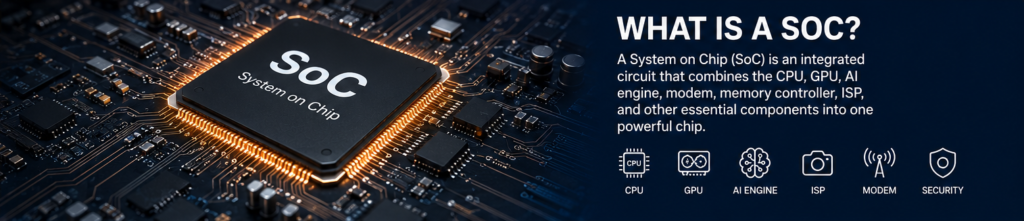
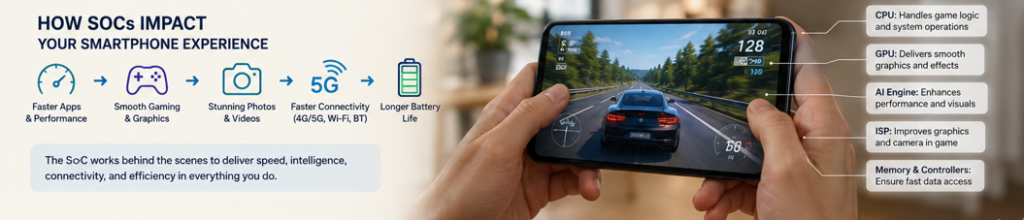
SoC stands for System on a Chip. It is an integrated circuit that combines multiple computing and hardware functions into one compact platform.
Instead of using separate chips for every major function, smartphone manufacturers can use an SoC to bring many of these functions together.
A typical smartphone SoC may include:
- CPU for general processing
- GPU for graphics and gaming
- NPU or AI accelerator for artificial intelligence tasks
- Image Signal Processor (ISP) for camera processing
- Memory controller
- Modem for cellular connectivity
- Security hardware
- Video encoding and decoding components
- Connectivity controllers
This integration allows manufacturers to build powerful smartphones while keeping the internal design compact and energy efficient.
Read Our Guide On:
How to Speed Up an Android Phone: 20+ Easy Tips
Why Are SoCs Important in Smartphones?
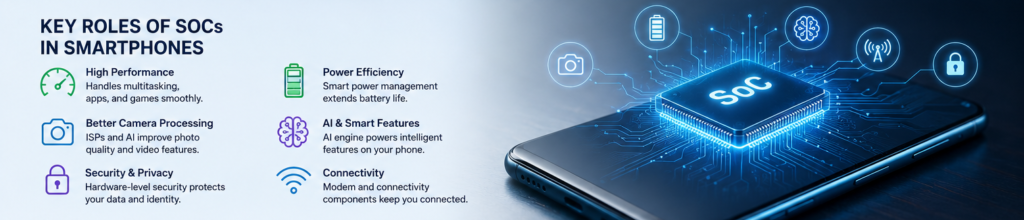
SoCs are important because smartphones need to perform many different tasks while operating from a relatively small battery.
A phone may need to:
- Run applications
- Play games
- Process photos and videos
- Connect to mobile networks
- Handle Wi-Fi and Bluetooth
- Run artificial intelligence features
- Protect personal data
- Manage power consumption
- Play high-resolution video
An SoC brings many of these functions together and allows them to communicate efficiently.
As a result, the SoC has a direct impact on the overall smartphone experience.
Key Takeaways
- SoC means System on a Chip.
- It combines multiple important hardware components into one integrated platform.
- The CPU handles general computing tasks.
- The GPU processes graphics and supports gaming.
- AI processors accelerate artificial intelligence features.
- The ISP helps process smartphone camera images and videos.
- Integrated connectivity components can handle cellular and wireless communication.
- A modern SoC can improve both performance and power efficiency.
- The SoC is important, but smartphone performance also depends on RAM, storage, software, cooling, and other hardware.
What Components Are Inside a Smartphone SoC?
Modern SoCs contain several specialized processing units. Each component has a different job.
1. CPU
The Central Processing Unit (CPU) is responsible for general-purpose computing.
It handles tasks such as:
- Opening applications
- Running the operating system
- Processing instructions
- Managing background processes
- Performing calculations
Modern smartphone CPUs commonly use multiple cores. Different cores may be designed for different performance and efficiency levels.
For example, a smartphone may use powerful cores for demanding tasks and efficiency-focused cores for lighter workloads.
This approach helps balance performance and battery consumption.
2. GPU
The Graphics Processing Unit (GPU) handles graphics-related workloads.
It is particularly important for:
- Mobile gaming
- 3D graphics
- User interface animations
- Video processing
- Augmented reality applications
A stronger GPU can help a smartphone run demanding games at higher frame rates and resolutions.
However, gaming performance does not depend on the GPU alone. Factors such as cooling, software optimization, display resolution, and sustained power also matter.
3. NPU or AI Accelerator
Many modern smartphone SoCs include a dedicated processor for artificial intelligence and machine-learning workloads.
This component may be called an NPU (Neural Processing Unit), AI engine, or another manufacturer-specific name.
AI hardware can accelerate features such as:
- Voice recognition
- Image recognition
- Photo enhancement
- Background removal
- Generative AI features
- Translation
- Noise reduction
- Smart camera processing
Dedicated AI hardware can perform certain tasks more efficiently than relying entirely on the CPU.
4. Image Signal Processor
The Image Signal Processor (ISP) is particularly important for smartphone photography.
When you take a photo, the camera sensor captures raw visual information. The ISP helps process this information before the final image is produced.
It can assist with:
- HDR processing
- Noise reduction
- Autofocus
- Exposure processing
- Color processing
- Computational photography
- Multi-camera processing
This is one reason two smartphones with similarly rated camera sensors can produce noticeably different photos.
The camera sensor is important, but the SoC’s image-processing capabilities and software also have a major influence on the final result.
5. Modem
Some smartphone SoCs include an integrated cellular modem.
The modem allows the phone to communicate with cellular networks such as 4G LTE and 5G.
Depending on the platform, the modem can influence:
- Cellular download speeds
- Upload speeds
- Network compatibility
- Connection reliability
- Power efficiency during cellular use
Some smartphone designs may use a separate modem rather than integrating it directly into the primary SoC.
6. Memory Controller
The memory controller manages communication between the processor and system memory.
Fast and efficient memory communication is important because applications constantly need to read and write data.
The memory controller works with technologies such as LPDDR memory to help deliver the bandwidth required by modern smartphone applications.
7. Security Hardware
Modern smartphone SoCs can also include dedicated security features.
These may help protect:
- Encryption keys
- Biometric information
- Sensitive user data
- Secure authentication
- Digital payments
- Device credentials
Hardware-based security can provide additional protection beyond software security alone.
How Does an SoC Affect Smartphone Performance?
The SoC is one of the biggest factors affecting smartphone performance.
When you open an application, browse the web, edit a video, or play a game, different parts of the SoC may become active.
For example:
Opening an app → CPU processes instructions → Memory system supplies data → GPU handles graphics → Display shows the result
For a demanding game, the CPU and GPU may work together continuously.
For an AI-powered camera feature, the ISP and AI accelerator may become more important.
Therefore, smartphone performance is not determined by CPU speed alone.
How Does an SoC Affect Battery Life?
An SoC also plays an important role in battery efficiency.
Smartphones have limited battery capacity, so manufacturers need processors that can provide high performance without constantly consuming large amounts of power.
Modern SoCs use several techniques to improve efficiency.
These can include:
- Efficient CPU cores
- Dynamic power management
- Specialized processing units
- Advanced manufacturing processes
- Integrated components
- Intelligent workload scheduling
For example, a lightweight background task does not necessarily need the phone’s most powerful CPU core.
The system can use more efficient hardware when possible and activate higher-performance components when necessary.
This can help extend battery life.
What Is the Difference Between an SoC and a CPU?
An SoC is not simply another name for a CPU.
A CPU is one processing component.
An SoC is a broader integrated platform that can contain a CPU along with several other components.
For example:
| Component | Main Function |
|---|---|
| CPU | General computing |
| GPU | Graphics and gaming |
| NPU/AI Accelerator | AI and machine learning |
| ISP | Camera and image processing |
| Modem | Cellular communication |
| Memory Controller | Communication with RAM |
| Security Hardware | Data and authentication protection |
This integration is one of the biggest advantages of smartphone SoCs.
How Do SoCs Help Smartphone Cameras?
Smartphone photography has become increasingly dependent on computational processing.
The camera sensor captures information, but the SoC helps turn that information into the final photograph.
For example, when you take an HDR photograph, the smartphone may combine information from multiple exposures.
The SoC can help process this information quickly.
It can also support computational photography features such as:
- Portrait effects
- Night photography
- HDR
- AI scene detection
- Skin and object recognition
- Image stabilization
- Video enhancement
- Real-time background effects
Because of this, the SoC can be just as important as the camera hardware for certain photography features.
How Do SoCs Help With Gaming?
Mobile games can place heavy demands on a smartphone.
The CPU handles game logic, while the GPU processes graphics.
At the same time, memory, storage, display hardware, and software all contribute to the gaming experience.
A capable SoC can help deliver:
- Higher frame rates
- Better graphics
- Faster game loading
- Improved visual effects
- Lower processing latency
- Better power efficiency
However, peak performance is not everything.
If a phone becomes too hot during extended gaming, it may reduce performance to control temperature. This is known as thermal throttling.
Therefore, sustained performance also depends on the smartphone’s cooling system and physical design.
How Do SoCs Support Artificial Intelligence?
Artificial intelligence has become a major part of modern smartphones.
Many devices now offer AI-powered features directly on the phone.
These may include:
- Real-time translation
- AI photo editing
- Voice assistants
- Object recognition
- Text summarization
- Generative AI tools
- Smart image processing
- Noise cancellation
A dedicated AI accelerator can process certain workloads more efficiently than using only the CPU.
This can also allow some AI tasks to happen directly on the device instead of constantly sending data to a cloud server.
SoC and Smartphone Connectivity
Connectivity is another important area affected by SoC design.
Modern smartphones may need to support several communication technologies, including:
- 4G
- 5G
- Wi-Fi
- Bluetooth
- GPS and other positioning technologies
Depending on the smartphone platform, some connectivity functions can be integrated into the SoC or supported through closely connected components.
Better integration can reduce the physical space required inside the phone and may improve power efficiency.
Why Do Different Smartphone SoCs Perform Differently?
Not every SoC is designed for the same purpose.
Some are designed for premium flagship smartphones, while others target mid-range or budget devices.
Performance can vary because of differences in:
- CPU architecture
- CPU core design
- GPU capability
- AI hardware
- Manufacturing process
- Memory support
- Modem technology
- Power management
- Thermal design
For example, a flagship SoC is generally designed to handle demanding gaming, advanced photography, high-resolution video, and AI workloads.
A budget-focused SoC may prioritize affordability and battery efficiency.
Does a More Powerful SoC Always Mean a Better Smartphone?
No.
A more powerful SoC can improve performance, but it does not automatically make a smartphone better in every way.
The overall smartphone experience also depends on:
- RAM
- Storage speed
- Display
- Battery capacity
- Cooling
- Camera sensors
- Operating system
- Software optimization
- Build quality
For example, a phone with an excellent SoC but poor software optimization may not feel as smooth as expected.
Similarly, a powerful processor may provide little benefit to someone who mainly uses messaging apps, social media, and web browsing.
What Are Some Popular Smartphone SoC Families?
Several companies develop smartphone processors and SoC platforms.
Some widely known examples include:
Qualcomm Snapdragon
Qualcomm develops Snapdragon platforms used in many Android smartphones.
Snapdragon platforms are available across different price categories, from entry-level devices to flagship smartphones.
Apple Silicon
Apple designs its own smartphone chips for the iPhone.
Apple’s A-series chips combine CPU, GPU, neural processing capabilities, image processing, and other functions into an integrated platform.
MediaTek Dimensity
MediaTek develops Dimensity smartphone platforms, including solutions for mid-range and premium Android devices.
These platforms combine processing, graphics, AI, imaging, and connectivity technologies.
Samsung Exynos
Samsung Electronics develops Exynos processors for smartphones and other devices.
Exynos platforms have been used across different Samsung smartphone product ranges.
How Is an SoC Made?
Developing a smartphone SoC is a complex process.
Chip designers first create the architecture and determine how different processing components will work together.
The design is then manufactured using semiconductor fabrication processes.
The manufacturing process is often described using a measurement in nanometers, such as 3 nm or 4 nm.
Smaller process technologies can potentially improve transistor density and power efficiency, although the process node alone does not determine the real-world performance of a chip.
The final SoC must also be tested for performance, stability, power consumption, heat, and compatibility.
SoC vs Processor: Are They the Same?
The terms are sometimes used interchangeably in everyday smartphone discussions, but technically they are different.
A processor can refer to a specific processing unit, such as a CPU.
An SoC combines multiple processing and supporting components into one integrated system.
Therefore, when someone says a smartphone has a particular SoC, they are usually referring to a complete processing platform rather than only the CPU.
How Can You Check Your Phone’s SoC?
If you want to find out which SoC your smartphone uses, there are several ways to check.
On Android
In Android you can usually find processor information in the device specifications or by using a trusted hardware information application.
The exact location varies by manufacturer.
On iPhone
Apple normally identifies its chip as part of the iPhone’s technical specifications.
You can also check the official specifications for your particular iPhone model.
Knowing your phone’s SoC can be useful when comparing smartphones, especially if performance, gaming, AI, or camera processing is important to you.
What Should You Look for When Comparing Smartphone SoCs?
If you are buying a new smartphone, don’t judge an SoC only by its name.
Consider the following:
CPU Performance
Look at how well the processor handles everyday and demanding workloads.
GPU Performance
This is especially important if you play graphics-intensive games.
Power Efficiency
A highly efficient chip can provide strong performance without unnecessarily draining the battery.
AI Performance
If you use AI-powered smartphone features, dedicated AI hardware can be valuable.
ISP and Camera Processing
For photography and video, image-processing capabilities can make a noticeable difference.
Modem and Connectivity
If you use 5G heavily, modem capabilities and supported network bands are important.
Sustained Performance
Don’t focus only on short benchmark scores. A phone should be able to maintain performance during longer workloads without excessive overheating.
Read Our Guide On:
Frequently Asked Questions
What is the role of SoC in smartphones?
The SoC provides the main computing platform for a smartphone. It combines components such as the CPU, GPU, AI accelerator, ISP, memory controller, and sometimes the modem to handle processing, graphics, cameras, connectivity, and other tasks.
Is an SoC the brain of a smartphone?
It is reasonable to describe the SoC as one of the smartphone’s main computing centers. However, a smartphone depends on many other components, including RAM, storage, sensors, battery, display, and software.
Does the SoC affect battery life?
Yes. SoC architecture, manufacturing technology, power management, and workload efficiency can significantly influence battery consumption.
Does the SoC affect camera quality?
Yes. The SoC’s image signal processor and AI capabilities can influence image processing, HDR, noise reduction, computational photography, and video features.
Does a better SoC make a phone faster?
Generally, a more capable SoC can improve performance, but actual speed also depends on RAM, storage, cooling, software optimization, and other hardware.
Is Snapdragon an SoC?
Snapdragon refers to a family of platforms developed by Qualcomm. Many Snapdragon smartphone platforms are SoCs that integrate multiple processing and connectivity components.
Why do smartphones use SoCs instead of separate chips?
SoCs save space, reduce communication overhead between components, and can improve power efficiency. This makes them particularly useful for compact battery-powered devices such as smartphones.
Are smartphone SoCs important for AI?
Yes. Modern SoCs often include dedicated AI hardware that can accelerate machine-learning and artificial-intelligence workloads.
Read Our Guide On:
Android vs iPhone for Students
Conclusion
So, what is the role of SoCs in smartphones? An SoC serves as a central integrated platform that brings together many of the technologies required for a modern smartphone.
It can include the CPU, GPU, AI accelerator, image signal processor, memory controller, modem, and security features. These components work together to handle everything from everyday applications and gaming to photography, video recording, AI features, and wireless communication.
The SoC is therefore one of the most important components to consider when evaluating a smartphone. However, it should not be viewed in isolation. RAM, storage, battery, display, cooling, cameras, and software optimization also play important roles.
Understanding SoCs makes it easier to compare smartphones and understand why different devices can offer very different levels of performance, battery life, camera processing, and AI capabilities.

Mehtab Hassan is the founder and tech writer at Brozly, where he publishes easy-to-understand articles on AI, software, cybersecurity, smartphones, laptops, and emerging technology. His goal is to help readers make smarter tech decisions through detailed reviews, practical tutorials, and beginner-friendly guides. He is passionate about exploring the latest innovations and delivering accurate, up-to-date content that everyone can understand.