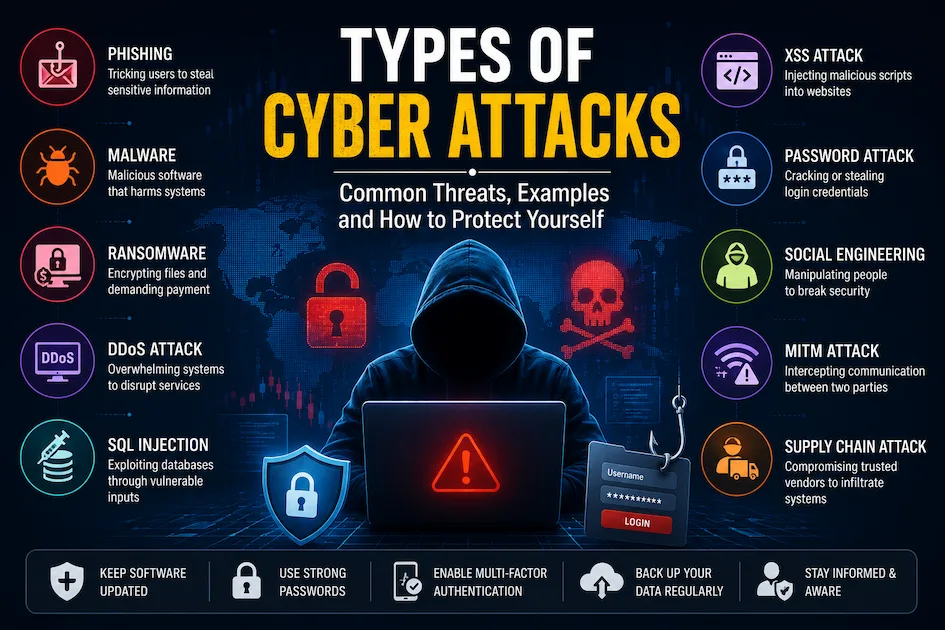
Cybersecurity is one of the most important topics in today’s digital world. Whether you use a smartphone, laptop, online banking, social media, or cloud storage, your personal information is constantly at risk from cyber threats.
From hackers stealing passwords to ransomware locking important files, cybercrime continues to grow every year. That’s why understanding cybersecurity is no longer just for IT professionals—it’s something everyone should know.
In this guide, you’ll learn what cybersecurity is, why it matters, how it works, its different types, common cyber threats, best practices, career opportunities, and much more.
What Is Cybersecurity?
Cybersecurity is the practice of protecting computers, smartphones, networks, servers, software, and data from cyberattacks, unauthorized access, theft, or damage.
Its main goal is to keep digital systems secure by protecting three important things:
- Confidentiality (keeping information private)
- Integrity (preventing unauthorized changes)
- Availability (making sure systems remain accessible)
Cybersecurity combines technology, security policies, employee awareness, and best practices to reduce digital risks.
Simply put, cybersecurity helps keep your digital life safe.
Organizations worldwide follow security standards such as the NIST Cybersecurity Framework to enhance their cybersecurity posture.
Read Our Guide On:
Why Is Cybersecurity Important?
Almost everything today happens online.
People use the internet for:
- Online banking
- Shopping
- Social media
- Healthcare
- Education
- Business communication
- Remote work
Because so much valuable information is stored digitally, cybercriminals constantly look for ways to steal it.
Without cybersecurity, organizations and individuals could face:
- Financial loss
- Identity theft
- Data breaches
- Business downtime
- Reputation damage
- Legal penalties
- Loss of customer trust
Good cybersecurity protects both individuals and businesses from these risks.
How Does Cybersecurity Work?
Cybersecurity works by combining multiple layers of protection.
Instead of relying on a single security tool, organizations use several security measures together.
These include:
Firewalls
Firewalls monitor incoming and outgoing network traffic.
They block suspicious connections before attackers reach your devices.
Antivirus Software
Antivirus programs detect:
- Malware
- Viruses
- Trojans
- Worms
- Spyware
They scan files and remove malicious software.
Encryption
Encryption converts readable information into unreadable code.
Even if hackers steal encrypted data, they cannot read it without the correct encryption key.
Multi-Factor Authentication (MFA)
MFA requires more than one verification method.
Examples include:
- Password
- Fingerprint
- Authentication app
- Security code
This makes accounts much harder to hack.
Security Monitoring
Organizations monitor their systems 24/7 to detect unusual activity before attacks spread.
Employee Training
Many attacks begin with human mistakes.
Cybersecurity awareness training helps employees identify phishing emails and other scams.
The Three Pillars of Cybersecurity (CIA Triad)
Cybersecurity is built around three core principles.
Confidentiality
Only authorized people should access sensitive information.
Examples:
- Password protection
- Encryption
- Access controls
Integrity
Data should remain accurate and unaltered.
Security tools ensure nobody changes information without permission.
Availability
Authorized users should access systems whenever needed.
Organizations use backups and disaster recovery plans to maintain availability.
Types of Cybersecurity
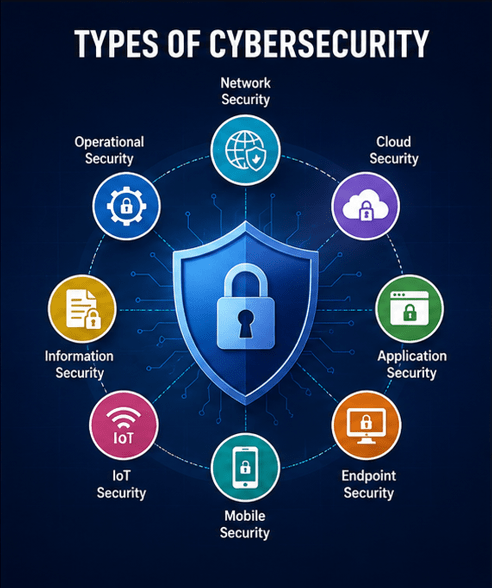
Cybersecurity includes several specialized areas.
Network Security
Protects computer networks from unauthorized access and attacks.
Common tools include:
- Firewalls
- VPNs
- Intrusion detection systems
Information Security
Protects sensitive data whether stored or transmitted.
It focuses on:
- Privacy
- Data integrity
- Secure storage
Application Security
Software applications often contain vulnerabilities.
Application security includes:
- Secure coding
- Software testing
- Regular updates
- Vulnerability scanning
Developers often follow the OWASP Top 10 to identify and fix common web application vulnerabilities
Cloud Security
Many businesses now use cloud platforms.
Cloud security protects:
- Cloud storage
- Cloud applications
- Virtual servers
- Customer data
Endpoint Security
Endpoints include:
- Laptops
- Smartphones
- Tablets
- Desktop computers
Each device must be protected from malware and unauthorized access.
Mobile Security
Smartphones store valuable information.
Mobile security protects against:
- Malicious apps
- Device theft
- Mobile malware
- Unsafe Wi-Fi networks
Internet of Things (IoT) Security
Smart devices include:
- Security cameras
- Smart TVs
- Smart speakers
- Smart locks
These connected devices also require protection.
Operational Security
Operational security focuses on policies and procedures for handling sensitive information securely.
Common Cyber Threats
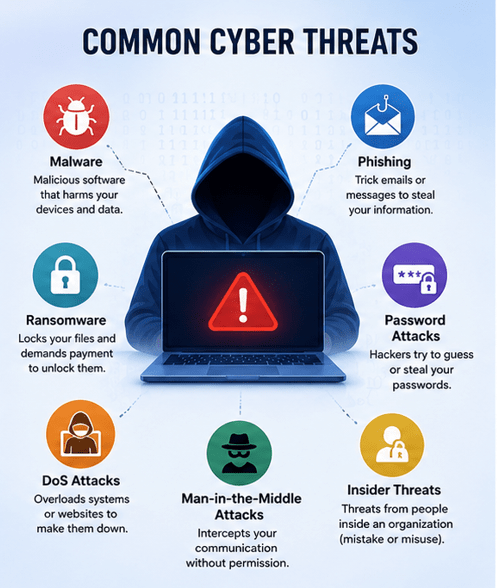
Understanding cyber threats helps you stay protected.
Malware
Malware refers to malicious software designed to damage systems.
Examples include:
- Viruses
- Worms
- Trojans
- Spyware
- Adware
Phishing
Phishing attacks trick users into revealing:
- Passwords
- Credit card information
- Banking details
Attackers often use fake emails pretending to be trusted companies.
Ransomware
Ransomware encrypts files and demands payment for their release.
Many businesses have lost millions because of ransomware attacks.
Password Attacks
Weak passwords make hacking much easier.
Attackers use:
- Brute-force attacks
- Dictionary attacks
- Credential stuffing
Denial-of-Service (DoS) Attacks
These attacks overload websites or servers with excessive traffic, causing them to stop working.
Man-in-the-Middle (MITM) Attacks
Hackers secretly intercept communication between two users.
This often happens on unsecured public Wi-Fi.
Insider Threats
Not all threats come from hackers.
Employees may accidentally or intentionally expose sensitive information.
Zero-Day Exploits
These attacks target software vulnerabilities before developers release security patches.
Common Cybersecurity Tools
Professionals use many security tools to protect systems.
Popular cybersecurity tools include:
- Antivirus software
- Firewalls
- VPNs
- Password managers
- Intrusion Detection Systems (IDS)
- Intrusion Prevention Systems (IPS)
- Security Information and Event Management (SIEM)
- Vulnerability scanners
- Backup software
- Endpoint Detection and Response (EDR)
Best Practices for Staying Safe Online
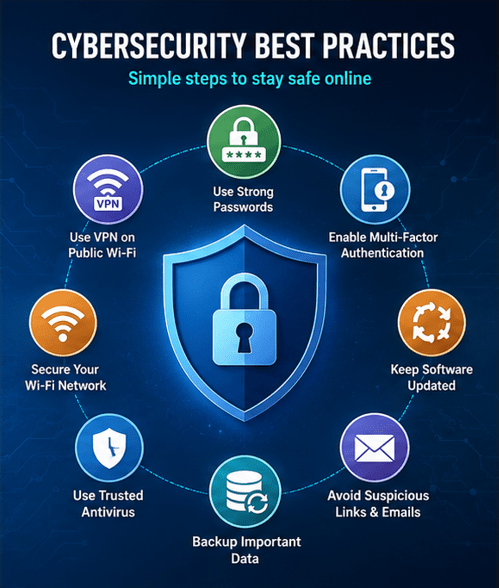
Everyone can improve their cybersecurity by following simple habits.
Use Strong Passwords
Create passwords that are:
- Long
- Unique
- Difficult to guess
Avoid using birthdays or common words.
Enable Multi-Factor Authentication
Always enable MFA on:
- Banking
- Social media
- Work accounts
Keep Software Updated
Software updates often fix security vulnerabilities.
Enable automatic updates whenever possible.
Avoid Suspicious Links
Never click unknown links in:
- Emails
- Text messages
- Social media
Always verify the sender first.
Backup Important Data
Regular backups protect your files from ransomware and hardware failure.
Use:
- External hard drives
- Cloud backups
Use Trusted Antivirus Software
Install reputable antivirus software and keep it updated.
Secure Your Wi-Fi Network
Protect home Wi-Fi by:
- Changing the default password
- Using WPA3 or WPA2 encryption
- Updating router firmware
Be Careful on Public Wi-Fi
Avoid accessing banking accounts over public Wi-Fi.
Use a VPN if necessary.
For more online safety tips, visit the Google Safety Center or explore the Microsoft Security website for guidance on protecting your devices and accounts.
Cybersecurity for Businesses
Businesses face increasingly sophisticated cyberattacks.
Strong cybersecurity protects:
- Customer data
- Financial information
- Business operations
- Intellectual property
Businesses should implement:
- Employee training
- Security policies
- Data backups
- Network monitoring
- Access control
- Incident response plans
- Regular security audits
Cybersecurity Careers
Cybersecurity has become one of the fastest-growing technology fields.
Popular job roles include:
- Cybersecurity Analyst
- Security Engineer
- Ethical Hacker
- Penetration Tester
- Security Consultant
- Digital Forensics Investigator
- Incident Response Analyst
- SOC Analyst
- Cloud Security Engineer
- Security Architect
Many organizations struggle to find qualified cybersecurity professionals, making it an excellent career choice.
Skills Needed for Cybersecurity
Important cybersecurity skills include:
Technical Skills
- Networking
- Linux
- Windows Administration
- Cloud Computing
- Python
- Security Tools
- Risk Assessment
- Vulnerability Management
Soft Skills
- Critical thinking
- Communication
- Problem-solving
- Attention to detail
- Continuous learning
Benefits of Cybersecurity
Cybersecurity offers many advantages.
These include:
- Protects personal information
- Prevents financial losses
- Reduces business risks
- Builds customer trust
- Ensures business continuity
- Improves regulatory compliance
- Prevents identity theft
- Protects company reputation
Challenges in Cybersecurity
Despite major advances, cybersecurity still faces challenges.
Common issues include:
- Increasing cybercrime
- Evolving malware
- AI-powered attacks
- Remote work security
- Human error
- Limited cybersecurity professionals
- Third-party risks
- Cloud security complexityOrganizations must constantly update their security strategies.
Future of Cybersecurity
Cybersecurity continues to evolve rapidly.
Emerging trends include:
- Artificial Intelligence in threat detection
- Machine Learning for security automation
- Zero Trust Architecture
- Cloud-native security
- IoT protection
- Biometric authentication
- Extended Detection and Response (XDR)
- Quantum-resistant encryption
As technology advances, cybersecurity will become even more important.
Cybersecurity vs Information Security
Many people confuse these terms.
| Cybersecurity | Information Security |
|---|---|
| Protects digital systems and networks | Protects all information, both digital and physical |
| Focuses on cyber threats | Focuses on information protection overall |
| Covers internet-connected devices | Covers documents, records, and digital files |
Cybersecurity is a part of the broader field of information security.
Who Needs Cybersecurity?
Cybersecurity is important for everyone.
This includes:
- Individuals
- Students
- Small businesses
- Large enterprises
- Government agencies
- Hospitals
- Schools
- Financial institutions
- Online shoppers
- Remote workers
Anyone using the internet should practice good cybersecurity habits.
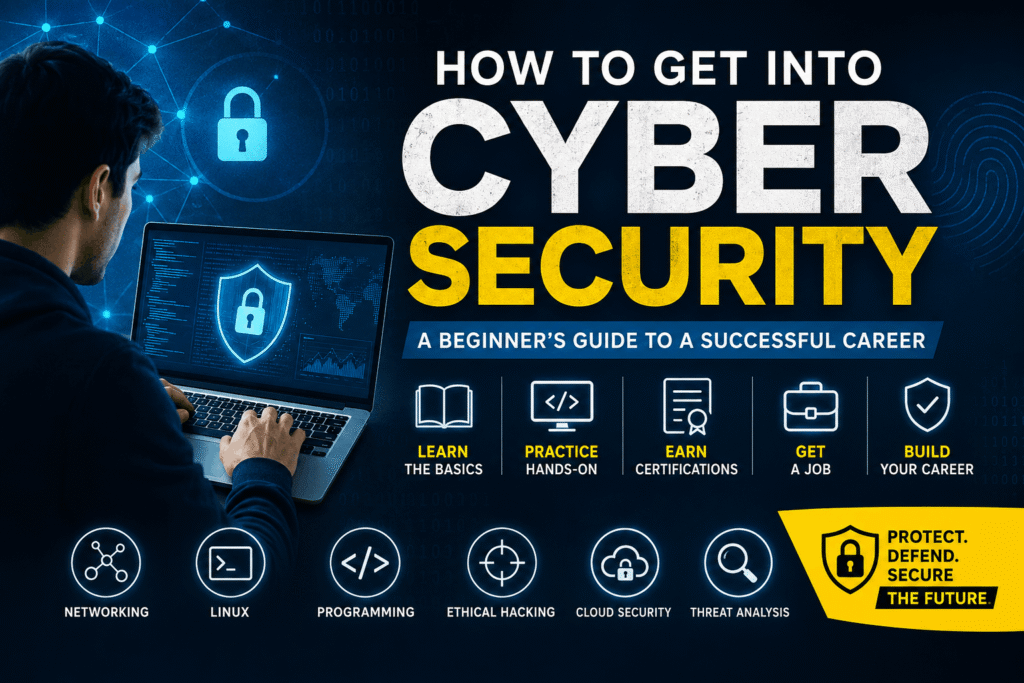
How to Get Into Cyber Security: A Beginner’s Guide
Conclusion
Cybersecurity is essential in today’s connected world. As more of our personal and professional lives move online, the risk of cyber threats continues to increase. Understanding the basics of cybersecurity helps you protect your devices, personal information, finances, and online accounts from attackers.
Whether you’re an individual browsing the internet, a business protecting customer data, or someone considering a career in technology, learning cybersecurity is a valuable investment. By using strong passwords, enabling multi-factor authentication, keeping software updated, and staying aware of common cyber threats, you can significantly reduce your risk and enjoy a safer digital experience.
Frequently Asked Questions (FAQs)
1. What is cybersecurity in simple words?
Cybersecurity is the practice of protecting computers, networks, devices, and data from hackers, viruses, and other online threats.
2. Why is cybersecurity important?
It protects sensitive information, prevents cyberattacks, reduces financial losses, and keeps digital systems secure.
3. What are the main types of cybersecurity?
The main types include network security, cloud security, application security, endpoint security, mobile security, information security, and IoT security.
4. What is a cyberattack?
A cyberattack is an attempt by hackers to steal, damage, or gain unauthorized access to digital systems or data.
5. What is malware?
Malware is malicious software designed to infect computers and steal, damage, or disrupt information.
6. Can beginners learn cybersecurity?
Yes. Many free courses, online labs, and certifications make cybersecurity accessible to beginners with no prior experience.
7. What are the best ways to stay safe online?
Use strong passwords, enable multi-factor authentication, keep software updated, avoid suspicious links, use antivirus software, and back up important data regularly.
8. Is cybersecurity a good career?
Yes. Cybersecurity is one of the fastest-growing industries, offering excellent salaries, job security, and strong demand worldwide.
9. What is the difference between cybersecurity and information security?
Cybersecurity focuses on protecting digital systems from cyber threats, while information security protects all types of information, including physical and digital data.
10. Can small businesses benefit from cybersecurity?
Absolutely. Even small businesses are common targets of cybercriminals, so implementing basic cybersecurity measures is essential for protecting customer data and business operations.
Read Our Guide On:
Cyber Hygiene Checklist: 20 Essential Tips to Stay Secure Online

Mehtab Hassan is the founder and tech writer at Brozly, where he publishes easy-to-understand articles on AI, software, cybersecurity, smartphones, laptops, and emerging technology. His goal is to help readers make smarter tech decisions through detailed reviews, practical tutorials, and beginner-friendly guides. He is passionate about exploring the latest innovations and delivering accurate, up-to-date content that everyone can understand.