Artificial intelligence has changed the way people write blog posts, emails, product descriptions, and social media content. AI tools can produce high-quality drafts within seconds, but one common problem remains: AI-generated content often sounds robotic.
Readers can quickly notice repetitive phrases, unnatural transitions, generic explanations, and overly formal language. Search engines also prioritize content that demonstrates real experience, expertise, and value rather than generic text.
The good news is that you can easily transform AI-generated content into natural, engaging, and human-friendly writing.
In this guide, you’ll learn exactly how to stop AI content generation from sounding robotic, improve readability, increase audience engagement, and create content that feels authentic. You can also read Google’s AI content guidance.
Read Our Guide On:
Comparing Best AI Image Generation Tools
Key Takeaways
- AI content sounds robotic because it often repeats patterns and lacks personality.
- Always edit AI-generated drafts before publishing.
- Use conversational language instead of overly formal wording.
- Add real-world examples, personal insights, and practical experience.
- Vary sentence length and structure.
- Remove repetitive words and phrases.
- Write for humans first and search engines second.
- Use AI as a writing assistant, not a replacement for human editing.
Why Does AI Content Sound Robotic?
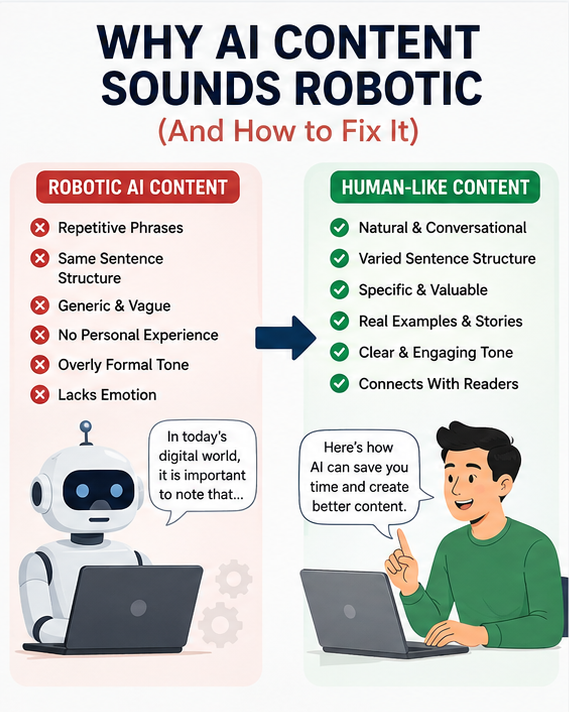
AI models predict the next most likely word based on patterns from training data. While this produces grammatically correct text, it often lacks the qualities that make human writing engaging.
Common reasons include:
- Repetitive sentence structures
- Generic explanations
- Overuse of transition words
- Predictable vocabulary
- No personal experience
- Little emotional connection
- Formal and unnatural tone
These characteristics make readers feel like they’re reading machine-generated content rather than advice from a real person.
Read Our Guide On:
How to Boost Your Productivity With AI Tools
Signs Your AI Content Sounds Robotic
Before fixing AI writing, you need to recognize the warning signs.
Repetitive Phrases
AI often repeats expressions such as:
- In today’s digital world…
- It is important to note…
- Furthermore…
- Additionally…
- Overall…
- In conclusion…
Using these repeatedly makes articles feel mechanical.
Every Paragraph Has the Same Length
Human writers naturally mix:
- Short paragraphs
- Medium paragraphs
- Longer explanations
AI often produces paragraphs with identical sizes, making reading monotonous.
No Personality
Robotic content usually lacks:
- Opinions
- Experience
- Stories
- Humor
- Examples
Readers connect with people—not machines.
Generic Advice
Instead of providing useful information, AI may produce vague statements such as:
“Businesses should use AI to improve productivity.”
A stronger version would explain:
“A marketing agency can use AI to draft email campaigns in minutes, allowing writers to spend more time improving messaging and conversion rates.”
Specific advice creates value.
How to Make AI Content Sound More Human
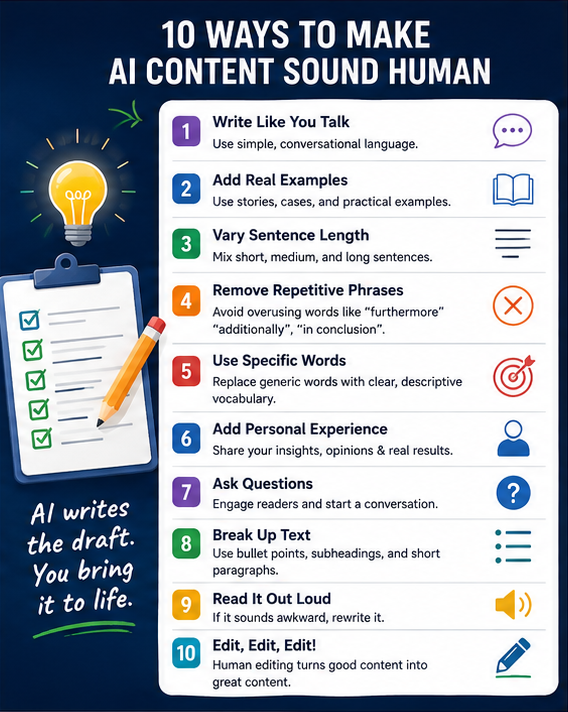
1. Rewrite the Introduction
Most AI introductions follow the same formula.
Instead of:
AI is transforming content creation across industries.
Try:
Have you ever read an article that felt technically correct but strangely lifeless? That’s one of the biggest challenges with AI-generated content.
The second version immediately connects with readers.
2. Write Like You’re Talking to Someone
Imagine explaining the topic to a friend.
Instead of:
Users should optimize readability.
Write:
Make your content easy to read so visitors stay longer on the page.
Simple language improves engagement.
3. Add Real Examples
Examples make content believable.
Instead of saying:
AI helps writers.
Explain:
A blogger can use AI to create a rough outline in five minutes and then spend time adding original research, examples, and personal insights.
Readers understand practical scenarios better than abstract statements.
4. Mix Short and Long Sentences
Robotic writing often follows one rhythm.
For example:
AI writes quickly. It saves time. It increases productivity.
Instead, vary the pace:
AI can save hours of work. But speed alone isn’t enough. Without editing, even the smartest AI can produce content that feels repetitive and generic.
This creates a more natural reading experience.
5. Remove Repetitive Transition Words
Instead of constantly using:
- Furthermore
- Moreover
- Additionally
- Therefore
Try natural alternatives:
- Also
- Another reason
- At the same time
- Even better
- For example
- On the other hand
Use transitions only where they improve flow.
6. Replace Generic Words
Instead of:
- Good
- Nice
- Important
- Helpful
- Better
Use descriptive language:
- Effective
- Practical
- Detailed
- Actionable
- Reliable
- Engaging
- Valuable
Specific vocabulary adds clarity.
7. Add Personal Experience
Search engines increasingly reward content that demonstrates experience.
For example:
After editing hundreds of AI-generated articles, one pattern appears repeatedly: the first draft is usually too formal. Spending even 15 minutes rewriting key sections dramatically improves readability.
Experience builds trust.
8. Ask Questions
Questions naturally involve readers.
Examples:
- Why does this happen?
- What can you improve?
- Have you noticed this problem?
- Which version sounds more natural?
Questions create conversation instead of one-way communication.
9. Break Up Large Blocks of Text
Large paragraphs discourage readers.
Instead, use:
- Bullet lists
- Numbered steps
- Tables
- Quotes
- Examples
- Short paragraphs
Better formatting improves user experience.
10. Read Content Out Loud
One of the simplest editing techniques is reading aloud.
If a sentence sounds awkward when spoken, rewrite it.
Natural speech usually creates natural writing.
Best Prompt to Reduce Robotic AI Writing
Instead of asking AI:
Write an article about AI writing.
Try a detailed prompt like this:
Write in a conversational tone using simple English. Avoid repetitive phrases and overly formal language. Vary sentence lengths. Add practical examples, natural transitions, and beginner-friendly explanations. Focus on clarity rather than keyword stuffing. Make the content sound like it was written by an experienced human editor.
Better prompts usually produce better first drafts.
Read Our Guide On:
Claude Prompts for Legal Document Summarization
Editing Checklist Before Publishing AI Content
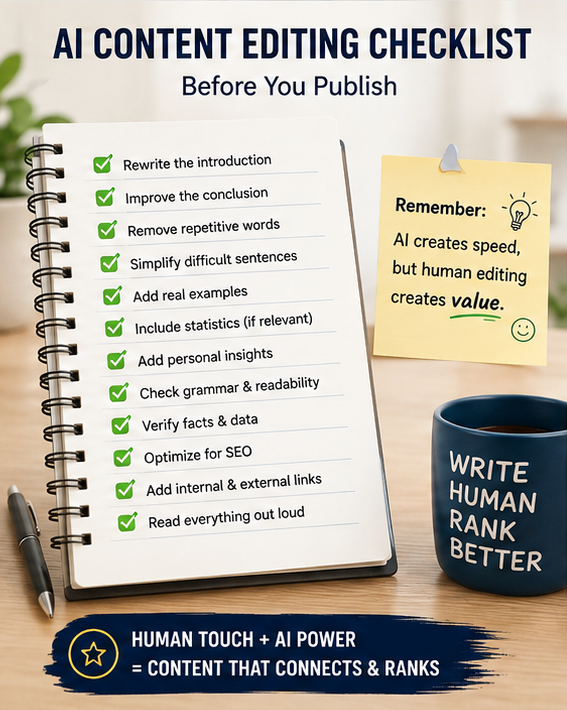
Use this checklist every time:
- Rewrite the introduction
- Improve the conclusion
- Remove repetitive wording
- Simplify difficult sentences
- Add examples
- Include statistics if relevant
- Add personal insights
- Check grammar
- Improve readability
- Verify facts
- Add internal links
- Add trusted external references
- Optimize headings
- Check keyword placement
- Read everything aloud
SEO Tips for Human-Like AI Content
Writing naturally also helps SEO.
Focus on Search Intent
Understand what readers actually want.
For this keyword, users want practical methods—not theory.
Answer those questions directly.
Use Semantic Keywords
Include naturally related phrases like:
- humanize AI content
- AI writing tips
- natural AI writing
- AI content editing
- conversational writing
- AI content optimization
- improve AI-generated content
- edit AI articles
Avoid forcing keywords into every paragraph.
Improve Readability
Search engines favor content that’s easy to understand.
Use:
- Short sentences
- Clear headings
- Bullet points
- White space
- Simple vocabulary
Demonstrate E-E-A-T
Google values:
- Experience
- Expertise
- Authoritativeness
- Trustworthiness
Strengthen your article by:
- Sharing practical experience
- Linking to reliable sources
- Explaining concepts accurately
- Updating content regularly
Common Mistakes to Avoid
Many writers make these errors:
Publishing AI Drafts Without Editing
AI should create the first draft—not the final version.
Stuffing Keywords
Adding the keyword repeatedly makes content unnatural.
Write for readers first.
Ignoring User Intent
Readers want solutions.
Avoid lengthy introductions that delay the answer.
Using Too Many Buzzwords
Avoid excessive use of phrases like:
- Revolutionary
- Game-changing
- Cutting-edge
- State-of-the-art
These words lose impact when overused.
Forgetting Fact Checking
AI can occasionally generate incorrect information.
Always verify:
- Statistics
- Dates
- Company details
- Product information
- Technical explanations
Accuracy builds credibility. For Outstanding content read Google’s Helpful Content Guidelines.
Recommended Workflow for Human-Like AI Content
A simple workflow can improve quality significantly.
- Generate a draft with AI.
- Rewrite the introduction.
- Add your own examples.
- Remove repetitive phrases.
- Improve headings.
- Simplify complex sentences.
- Check facts.
- Optimize for SEO.
- Read aloud.
- Publish.
This process balances AI efficiency with human creativity.
The Future of AI Writing
AI writing tools will continue to improve, but human editing will remain essential.
The most successful content creators will use AI to speed up research and drafting while relying on human judgment to add originality, accuracy, emotion, and real-world experience.
Rather than replacing writers, AI is becoming a productivity tool that helps professionals create better content faster.
Frequently Asked Questions
Is AI-generated content bad for SEO?
No. Google focuses on content quality rather than whether AI assisted in creating it. Helpful, accurate, original, and user-focused content can perform well regardless of how it was produced.
How can I make AI writing sound more natural?
Edit the draft carefully, use conversational language, add examples, vary sentence structure, remove repetitive wording, and include personal insights where appropriate.
Can Google detect AI-generated content?
Google evaluates the quality and usefulness of content rather than simply whether AI was involved. Low-quality, spammy, or unhelpful content may perform poorly regardless of how it was created.
Should I publish AI-generated content without editing?
No. AI-generated drafts should always be reviewed for accuracy, readability, originality, and tone before publishing.
What is the best way to humanize AI content?
Rewrite introductions, add unique examples, use natural language, simplify complex sentences, include real experiences, and thoroughly edit every section before publishing.
Read Our Guide:
Best AI Tools for Real Estate in 2026
Conclusion
Learning how to stop AI content generation from sounding robotic is an essential skill for modern writers, marketers, bloggers, and businesses.
AI can dramatically speed up content creation, but great writing still requires human judgment. By rewriting key sections, adding examples, improving readability, varying sentence structure, and focusing on real value, you can create content that readers trust and search engines reward.
Treat AI as your writing partner—not your replacement. With thoughtful editing and a reader-first approach, you’ll consistently produce content that feels authentic, engaging, and genuinely helpful.
Read Our Guide On:
Is DeepSeek Better Than ChatGPT?

Mehtab Hassan is the founder and tech writer at Brozly, where he publishes easy-to-understand articles on AI, software, cybersecurity, smartphones, laptops, and emerging technology. His goal is to help readers make smarter tech decisions through detailed reviews, practical tutorials, and beginner-friendly guides. He is passionate about exploring the latest innovations and delivering accurate, up-to-date content that everyone can understand.