Artificial intelligence (AI) is changing how real estate professionals find leads, market properties, communicate with clients, and close deals. Tasks that once took hours can now be completed in minutes with the help of AI-powered software.
Whether you’re a real estate agent, broker, investor, property manager, or agency owner, using the right AI tools can improve productivity, reduce manual work, and help you stay ahead of the competition.
In this guide, you’ll discover the best AI tools for real estate, their features, pricing, pros and cons, and how to choose the right one for your business.

Key Takeaways
- AI reduces repetitive work like writing listings, answering inquiries, and scheduling appointments.
- AI-powered CRMs help agents convert more leads.
- Virtual staging tools make empty homes look professionally furnished.
- AI chatbots provide 24/7 customer support.
- Predictive analytics help investors identify profitable opportunities.
- AI marketing tools generate social media posts, emails, blogs, and advertisements in minutes.
- The best results come from combining multiple AI tools instead of relying on just one.
What Are AI Tools for Real Estate?
AI tools for real estate are software applications that use artificial intelligence to automate repetitive tasks, analyze market data, create marketing content, generate leads, answer customer questions, and improve decision-making.
Instead of replacing real estate professionals, AI acts as a smart assistant that saves time and helps professionals focus on building relationships with clients.
Common AI capabilities include:
- Property description writing
- Email generation
- Lead qualification
- Virtual staging
- Chatbots
- Market analysis
- Price prediction
- Customer support
- Image enhancement
- Social media content creation
Why AI Is Important in Real Estate
The real estate industry is becoming more competitive every year.
Buyers expect instant responses.
Sellers expect better marketing.
Agents need to manage dozens of clients simultaneously.
AI helps by:
- Automating repetitive work
- Improving customer experience
- Generating marketing content faster
- Responding to inquiries 24/7
- Saving time
- Increasing productivity
- Helping agents make data-driven decisions
Best AI Tools for Real Estate
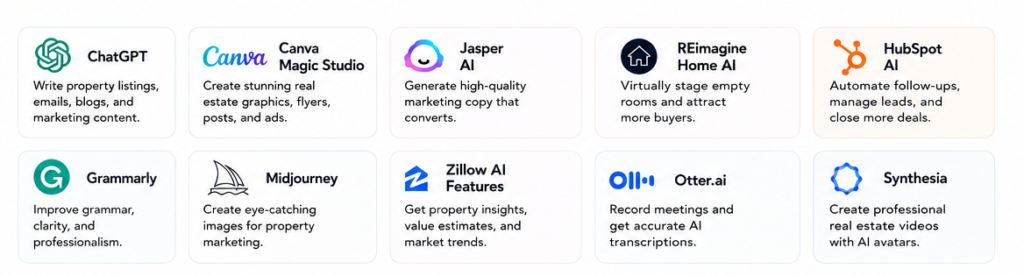
1. ChatGPT
Best for: Content writing, emails, property descriptions, client communication
ChatGPT has become one of the most useful AI assistants for real estate professionals.
It can write:
- Property listings
- Email campaigns
- Buyer follow-ups
- Social media captions
- Blog posts
- Marketing plans
- Video scripts
- Open house announcements
Pros
- Easy to use
- Saves hours of writing
- Excellent content quality
- Supports brainstorming
- Multiple language support
Cons
- Requires good prompts
- Needs fact-checking
2. Canva Magic Studio
Best for: Real estate marketing
Canva’s AI features help agents create:
- Property flyers
- Instagram posts
- Facebook ads
- Brochures
- Presentations
- Listing graphics
AI can also remove backgrounds, generate images, resize designs, and write marketing copy.
Pros
- Beginner-friendly
- Huge template library
- Fast design creation
Cons
- Some AI features require a paid plan
3. Jasper AI
Best for: Marketing copy
Jasper specializes in AI-powered content creation.
Real estate businesses use it for:
- Landing pages
- Email campaigns
- Listing descriptions
- Google Ads
- Facebook Ads
- SEO articles
Pros
- Excellent marketing templates
- SEO-friendly content
- Brand voice support
Cons
- Higher price than some alternatives
4. Grammarly
Best for: Professional communication
Grammarly helps agents improve:
- Emails
- Contracts
- Property descriptions
- Blog posts
- Client messages
Its AI checks grammar, tone, clarity, and professionalism.
Pros
- Very accurate
- Easy browser extension
- Improves writing quality
Cons
- Advanced features require Premium
5. Midjourney
Best for: AI-generated marketing images
Midjourney creates attractive visuals for:
- Luxury listings
- Promotional graphics
- Concept home designs
- Real estate advertisements
It is especially useful when creating marketing materials.
Pros
- High-quality images
- Creative outputs
- Great for branding
Cons
- Learning curve
- Discord-based workflow
Read Our Guide On:
How to Fix Midjourney Blurred Text Error
6. REimagineHome AI
Best for: Virtual staging
Empty properties often receive less attention.
REimagineHome AI virtually stages rooms by adding furniture, decor, lighting, and design styles.
This helps buyers imagine the property’s potential.
Pros
- Affordable
- Fast staging
- Multiple design styles
Cons
- Not suitable for every property photo
7. Zillow AI Features
Best for: Property insights
Some AI-powered features help users:
- Estimate property values
- Analyze neighborhood data
- Compare homes
- Understand market trends
These insights assist buyers and sellers in making informed decisions.
Pros
- Trusted platform
- Valuable market data
Cons
- Available features vary by location
8. Otter.ai
Best for: Meeting transcription
Real estate agents attend numerous meetings every week.
Otter AI records conversations and creates searchable transcripts automatically.
Useful for:
- Buyer consultations
- Team meetings
- Property discussions
- Client interviews
Pros
- Accurate transcription
- Saves notes automatically
Cons
- Limited free plan
9. Synthesia
Best for: AI videos
Synthesia allows agents to create professional videos without recording themselves.
Create:
- Property walkthrough introductions
- Market updates
- Educational content
- Training videos
Pros
- Professional avatars
- Multiple languages
- Easy editing
Cons
- Premium pricing
10. HubSpot AI
Best for: CRM automation
HubSpot combines CRM with AI.
It helps manage:
- Leads
- Follow-ups
- Email automation
- Sales pipeline
- Customer relationships
Pros
- Powerful automation
- Excellent reporting
- CRM integration
Cons
- Advanced plans can be expensive
Comparison Table
| Tool | Best For | Free Plan | Beginner Friendly |
|---|---|---|---|
| ChatGPT | Writing | Yes | (5/5) |
| Canva Magic Studio | Marketing | Yes | (5/5) |
| Jasper | Marketing Copy | Limited | (4/5) |
| Grammarly | Writing | Yes | (5/5) |
| Midjourney | Images | No | (3/5) |
| REimagineHome AI | Virtual Staging | Limited | (4/5) |
| Zillow AI | Market Research | Yes | (5/5) |
| Otter AI | Meeting Notes | Yes | (5/5) |
| Synthesia | Videos | Limited | (4/5) |
| HubSpot AI | CRM | Yes | (4/5) |
Read Our Guide On:
How to Boost Your Productivity With AI Tools
How to Choose the Right AI Tool
Before subscribing to any AI software, consider:
Your Goals
Ask yourself:
- Do you need more leads?
- Better marketing?
- Faster writing?
- CRM automation?
- Video creation?
Budget
Many AI tools offer free plans.
Start free before upgrading.
Ease of Use
Choose tools that your team can learn quickly.
Integration
Look for software that integrates with:
- CRM
- Google Workspace
- Microsoft Office
- Marketing platforms
Customer Support
Reliable support becomes important as your business grows.
Benefits of AI in Real Estate
Using AI can provide many advantages.
Saves Time
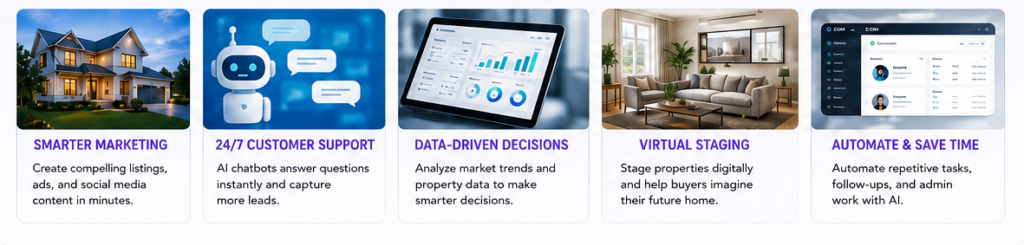
AI automates repetitive tasks like writing, scheduling, and responding to inquiries.
Better Marketing
Generate professional ads, social media posts, and listing descriptions in minutes.
Improved Customer Service
AI chatbots answer questions 24/7.
Higher Productivity
Agents spend more time selling instead of handling repetitive administrative work.
Better Decision-Making
AI analyzes large amounts of property and market data quickly.
Increased Lead Conversion
AI helps identify high-quality leads and automate follow-up sequences.
Limitations of AI in Real Estate
Although AI is powerful, it has limitations.
- May generate incorrect information
- Cannot replace local market expertise
- Requires human review
- Some tools are expensive
- Privacy concerns when handling client data
- AI cannot replace personal relationships
The best results come from combining AI with human expertise.
AI Use Cases in Real Estate
Real estate professionals use AI for:
Property Listings
Generate compelling property descriptions quickly.
Social Media
Create daily marketing posts automatically.
Email Marketing
Write personalized client emails.
Lead Qualification
Identify serious buyers faster.
Virtual Staging
Stage empty homes digitally.
Price Analysis
Analyze market trends and pricing.
Customer Support
Answer common questions using AI chatbots.
SEO Content
Create blogs that attract organic traffic.
Future of AI in Real Estate
AI technology continues to improve rapidly.
Future developments may include:
- Smarter property recommendations
- AI-powered negotiations
- Predictive investment analysis
- Fully automated marketing campaigns
- More realistic virtual property tours
- Voice-powered real estate assistants
- Better fraud detection
- Personalized buying experiences
Agents who adopt AI early are likely to gain a competitive advantage.
Tips for Using AI Successfully
To get the most value from AI:
- Always verify AI-generated information.
- Add your local market knowledge to AI content.
- Use AI to assist—not replace—client relationships.
- Keep client data secure.
- Test multiple AI tools before committing to a paid plan.
- Stay updated with new AI features and industry trends.
Read Our Guide On:
Claude Prompts for Legal Document Summarization
Frequently Asked Questions
What is the best AI tool for real estate agents?
ChatGPT is one of the best all-around AI tools for writing, marketing, client communication, and productivity. However, the ideal tool depends on your specific needs.
Can AI generate property descriptions?
Yes. AI can create professional, engaging, and SEO-friendly property descriptions in seconds. Always review the content for accuracy before publishing.
Is AI replacing real estate agents?
No. AI automates repetitive tasks, but buyers and sellers still value human expertise, negotiation skills, and personalized advice.
Which AI tool is best for virtual staging?
REimagineHome AI is one of the leading tools for virtual staging, allowing agents to furnish empty rooms digitally.
Can AI help generate real estate leads?
Yes. AI can qualify leads, automate follow-ups, personalize email campaigns, and improve marketing strategies to increase lead generation.
Are AI tools expensive?
Many AI tools offer free plans or free trials. Premium features are available through monthly subscriptions, making them accessible for individuals and businesses of different sizes.
Is AI useful for real estate investors?
Yes. Investors use AI to analyze market trends, estimate property values, identify investment opportunities, and automate research.
What should I look for when choosing an AI tool?
Consider your goals, budget, ease of use, integrations, customer support, and the specific tasks you want to automate.
Read Our Guide On:
10 Best AI Tools for Students in 2026
Conclusion
AI is transforming the real estate industry by helping professionals work faster, market properties more effectively, and deliver better customer experiences. From writing property listings with ChatGPT to designing marketing materials in Canva, staging homes with REimagineHome AI, and managing leads through HubSpot AI, there are tools available for nearly every aspect of the business.
The best AI tools for real estate won’t replace experienced agents—they’ll enhance their capabilities. By choosing the right combination of AI solutions and combining them with local expertise and strong client relationships, you can save time, improve efficiency, and grow your real estate business in an increasingly competitive market.
Whether you’re just starting out or managing a large agency, now is an excellent time to explore AI and integrate it into your daily workflow for smarter, more efficient real estate operations.
Read Our Guide On:
12 Best V0 by Vercel Alternatives in 2026

Mehtab Hassan is the founder and tech writer at Brozly, where he publishes easy-to-understand articles on AI, software, cybersecurity, smartphones, laptops, and emerging technology. His goal is to help readers make smarter tech decisions through detailed reviews, practical tutorials, and beginner-friendly guides. He is passionate about exploring the latest innovations and delivering accurate, up-to-date content that everyone can understand.