Custom software development means creating software specifically for the needs of a particular business, organization, or group of users. Instead of using a ready-made application with fixed features, a business can work with developers to create a solution around its own workflows, goals, data, and requirements.
For example, a company may need a system that manages customers, inventory, employees, orders, payments, and reports in one place. If existing software cannot handle those requirements effectively, custom development can provide a more suitable solution.
In simple terms, custom software development creates software around a specific problem instead of asking a business to change its processes to fit a generic application.
How Does Custom Software Development Work?
A custom software project usually follows a structured development process. The exact approach can vary, but most projects include requirements analysis, design, development, testing, deployment, and ongoing maintenance.
NIST describes the software development life cycle (SDLC) as a methodology for designing, creating, and maintaining software.
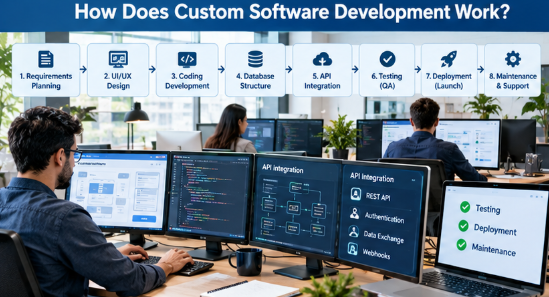
1. Requirements and Planning
First, the development team needs to understand the problem.
The team talks with stakeholders, identifies the target users, and documents the features the software should provide. They may also examine existing workflows, technical requirements, integrations, security needs, and future goals.
Good planning matters because unclear requirements can lead to unnecessary development work later.
2. Software Design
Next, developers and designers create the structure of the application.
This stage can include:
- User interface design
- Database planning
- System architecture
- User roles and permissions
- Application workflows
- API and integration planning
The team may also create wireframes or prototypes. These early designs help stakeholders understand how the final application should work before developers build the complete system.
3. Development
After the team agrees on the requirements and design, developers start building the software.
They write code, create databases, connect APIs, configure services, and develop the application’s features. Modern development teams often work in smaller iterations, allowing them to review progress and adjust requirements as the project develops.
4. Testing
Testing helps the team find problems before users rely on the software.
Developers can test individual components, connections between components, complete workflows, performance, usability, and security. User testing can also provide valuable feedback before launch.
Microsoft identifies testing as a core phase of the software development life cycle and notes that different projects may require different types of testing.
5. Deployment
Once testing shows that the application meets its requirements, the team prepares it for real users.
Deployment may involve servers, cloud infrastructure, databases, domains, authentication systems, backups, and monitoring.
The team should also prepare a plan for handling unexpected problems during the initial release.
6. Maintenance and Improvement
Development does not necessarily stop after launch.
Instead, the organization may continue fixing bugs, improving performance, adding features, updating dependencies, and addressing security issues.
Therefore, businesses should consider ongoing maintenance when they plan a custom software project. Microsoft also treats maintenance as a continuous part of the software life cycle.
What Are Examples of Custom Software?
Custom software can solve many different business problems. The final product depends on what the organization actually needs.
Common examples include:
- Custom customer relationship management (CRM) systems
- Inventory management software
- Employee management platforms
- Booking and scheduling systems
- Customer portals
- Healthcare management applications
- Financial management systems
- Logistics platforms
- Business reporting dashboards
- E-commerce applications
- Workflow automation tools
- Industry-specific mobile apps
For instance, a delivery company might need software that combines order management, driver assignments, delivery tracking, customer notifications, and reporting. A general application may handle some of these tasks, but a custom platform can connect them around the company’s specific workflow.
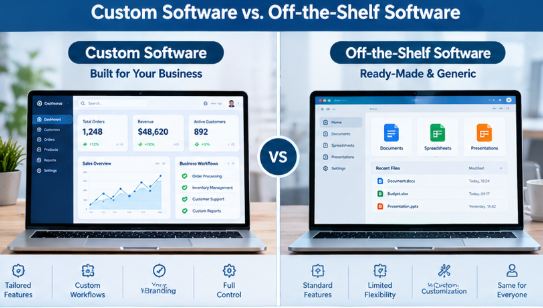
Custom Software vs. Off-the-Shelf Software
The main difference comes down to how the software gets designed.
Custom software starts with the requirements of a particular organization. Off-the-shelf software, on the other hand, already exists as a commercial product and targets a wider group of customers. NIST defines commercial off-the-shelf software as software that already exists and is commercially available.
| Custom Software | Off-the-Shelf Software |
|---|---|
| Built around specific requirements | Built for a broad market |
| Offers greater control over features | Provides predefined features |
| Can target specialized workflows | Usually follows standard workflows |
| May require more development time | Can often be adopted faster |
| Requires an ongoing maintenance strategy | Vendor usually manages the core product |
| Can support specialized integrations | Integration options depend on the product |
However, custom software does not automatically make the better choice. A business with simple requirements may find an existing product more practical, while an organization with highly specialized workflows may need greater flexibility.
What Are the Benefits of Custom Software Development?
It Can Match Specific Business Processes
One major advantage is the ability to build software around existing business processes.
Instead of asking employees to adapt to a generic workflow, developers can create features that support the way the organization actually operates.
It Can Provide Greater Flexibility
A custom application can include specific user roles, workflows, reports, integrations, and features.
As a result, businesses can shape the software around their operational requirements rather than selecting only from a fixed feature set.
It Can Integrate With Existing Systems
Many businesses already use multiple systems for accounting, customer management, payments, inventory, communication, or reporting.
Custom software can incorporate APIs and other integration methods when those systems support them. This approach can help different parts of the business exchange information more efficiently.
It Can Support Future Changes
Businesses rarely remain exactly the same for years.
New products, employees, customers, regulations, and processes can change software requirements. A well-designed custom application can give developers more control when the organization needs to expand or modify the system.
However, future flexibility depends heavily on good architecture and maintainable code. Simply calling software “custom” does not guarantee easy expansion.

What Are the Disadvantages of Custom Software?
Custom development also introduces several challenges.
Higher Initial Development Effort
Developers must analyze requirements, design the system, write code, test the application, and prepare the production environment.
Consequently, custom development can require more initial investment than adopting an existing product.
Longer Time to Launch
An off-the-shelf product already exists. A custom application starts as a set of requirements and must go through development before users can rely on it.
For this reason, businesses should consider whether they need a specialized solution badly enough to justify the additional development time.
Ongoing Maintenance
After launch, the organization still needs to maintain the application.
Developers may need to fix bugs, update dependencies, improve performance, address security vulnerabilities, and introduce new features.
Project Complexity
Large applications can involve many stakeholders, integrations, databases, security requirements, and technical decisions.
Therefore, clear project management and communication become especially important.
When Should a Business Choose Custom Software?
Custom development can make sense when an organization has requirements that existing products cannot handle effectively.
Consider custom software when:
- Your workflow differs significantly from standard business processes.
- Existing products lack important features.
- Several systems need specialized integration.
- Software plays an important role in your operations.
- You need specialized reporting or automation.
- Your organization expects significant changes or growth.
- You need control over specific application features and workflows.
On the other hand, an existing software product may work well when your requirements are common and the product already provides the features you need.
The decision should therefore come from the actual business problem, not simply from the desire to have “custom” software.
Is Custom Software Secure?
Custom software can include security requirements from the beginning, but custom development does not automatically make an application secure.
Security should remain part of the entire development process. For example, teams can consider authentication, authorization, encryption, secure coding, testing, logging, monitoring, and vulnerability management throughout the software life cycle.
Microsoft recommends incorporating security measures across SDLC stages, including planning, design, development, testing, deployment, and maintenance.
Similarly, NIST provides software development guidance that emphasizes structured development practices and security considerations.
How Much Does Custom Software Development Cost?
There is no single price for custom software development.
The final cost depends on factors such as:
- Number and complexity of features
- Application type
- Number of users
- Web, mobile, or desktop requirements
- Third-party integrations
- Database requirements
- Security requirements
- Testing requirements
- Development team
- Hosting and infrastructure
- Ongoing maintenance
A simple internal application and a large platform with thousands of users can have completely different development requirements.
Therefore, a reliable estimate normally requires a clear project scope and detailed requirements.
What Makes a Custom Software Project Successful?
Good software development starts with a clear understanding of the problem.
Before development begins, stakeholders should define the application’s goals, users, essential features, technical requirements, and success criteria.
After that, the team should maintain clear communication throughout development. Regular testing, documentation, security reviews, and user feedback can also help identify problems before they become expensive to fix.
Ultimately, successful custom software should solve a real problem, remain maintainable, and provide enough value to justify its development and ongoing operating costs.
Frequently Asked Questions
What is custom software development in simple words?
Custom software development means building an application specifically for the requirements of a particular business, organization, or group of users.
What is an example of custom software?
A company-specific inventory platform, employee management system, logistics application, customer portal, or specialized CRM can all qualify as custom software when developers build them around specific organizational requirements.
Is custom software better than off-the-shelf software?
Not in every situation. Custom software offers greater flexibility, while off-the-shelf products can provide faster access to established features. The right option depends on the organization’s requirements and resources.
How long does custom software development take?
The timeline depends on the project’s scope. A small application may require much less development work than a large platform with multiple integrations, user roles, databases, and security requirements.
Can custom software be changed after launch?
Yes. Developers can update custom software after launch to fix problems, improve existing features, add new functionality, or support changing business requirements.
Does custom software require maintenance?
Yes. Businesses should plan for ongoing maintenance because software may need security updates, bug fixes, performance improvements, dependency updates, and new features over time.
Final Thoughts
Custom software development gives businesses a way to build technology around their own requirements rather than relying entirely on generic features.
The process usually involves planning, requirements analysis, design, development, testing, deployment, and ongoing maintenance.
However, custom software is not automatically the right solution for every business. If an existing product already solves the problem effectively, an off-the-shelf option may require less development effort. If the business has specialized workflows or requirements that existing products cannot handle, custom development may provide the flexibility it needs.
The most important question, therefore, is not simply whether a business can build custom software. Instead, it is whether a custom solution can solve a specific problem well enough to justify its development and long-term maintenance.