Is cybersecurity a good career in 2026? For people who enjoy technology, solving problems, and protecting digital information, cybersecurity can be a rewarding career choice. Businesses, government agencies, healthcare providers, and financial institutions all depend on secure computer systems to protect sensitive data and maintain their operations.
However, cybersecurity is not an easy shortcut to a high-paying job. It requires technical knowledge, practical experience, continuous learning, and the ability to respond to changing security threats. Beginners also need to understand that their first cybersecurity job may require a different set of skills than more advanced positions.
In this guide, we will explore cybersecurity career opportunities, salary expectations, essential skills, advantages and disadvantages, and the steps beginners can take to enter the field.
Is Cybersecurity a Good Career in 2026?
Yes, cybersecurity can be a good career in 2026, especially for people who are willing to build strong technical foundations and develop their skills over time.

Organizations face risks from phishing, ransomware, data breaches, stolen credentials, and other cyberattacks. Cybersecurity professionals help prevent these incidents, identify suspicious activity, investigate security problems, and protect important systems.
The US Bureau of Labor Statistics projects that employment for information security analysts will grow by 21% from 2025 to 2035, much faster than the average for all occupations. This is a positive indicator of demand in the United States, although job opportunities vary by country, employer, experience, and specialization.
Cybersecurity also offers several career paths. You could work in security operations, cloud security, digital forensics, incident response, penetration testing, or security engineering.
The best choice depends on your interests, technical strengths, and willingness to keep learning.
Why Is Cybersecurity a Promising Career?
Several factors make cybersecurity worth considering as a long-term career.
Growing Need for Digital Security
Businesses increasingly depend on online services, cloud platforms, digital payments, and connected devices. These technologies create opportunities but also introduce security risks.
Cybersecurity professionals help organizations identify vulnerabilities, protect networks, secure applications, and respond to incidents. As digital systems become more complex, security remains an important business concern.
Opportunities Across Different Industries
Cybersecurity is not limited to technology companies. Banks, hospitals, universities, retailers, government departments, and manufacturers also need to protect their digital information.
This creates opportunities for professionals with different backgrounds and interests. Someone interested in finance, for example, might work on protecting banking systems, while another person might focus on securing cloud infrastructure or healthcare data.
Multiple Career Paths
Cybersecurity is a broad field rather than a single job. You can start by learning general IT and security fundamentals before choosing a specialization.
Some professionals prefer monitoring security alerts and investigating incidents. Others enjoy testing systems, analyzing malicious software, or designing secure networks.
Having several possible career paths makes cybersecurity attractive to people who want room to develop professionally.
Potential for Career Growth
With experience, cybersecurity professionals may progress into senior analyst, security engineer, incident response lead, security architect, or management positions.
Career progression depends on practical skills, performance, relevant experience, and employer requirements. Certifications and a degree can also help, but neither guarantees employment.
What Does a Cybersecurity Professional Do?
Daily responsibilities depend on the specific role. Common tasks include:
- Monitoring networks and systems for suspicious activity.
- Investigating security alerts and potential incidents.
- Identifying vulnerabilities and recommending improvements.
- Helping protect sensitive information through access controls and encryption.
- Reviewing security logs and documenting findings.
- Supporting incident response and recovery activities.
- Educating employees about phishing and other security risks.
- Keeping up with emerging threats, tools, and defensive techniques.
For example, a security analyst might investigate an unusual login, determine whether an account has been compromised, and work with other IT staff to contain the threat.
A penetration tester has a different responsibility: testing systems with explicit authorization to identify weaknesses before malicious attackers exploit them.
These roles require different skills, but both contribute to protecting digital environments.
Cybersecurity Salary and Job Outlook
Salary is an important consideration when deciding whether cybersecurity is a good career. Earnings vary depending on location, experience, industry, specialization, and employer.
According to the US Bureau of Labor Statistics, the median annual wage for information security analysts was $129,180 in May 2025. The agency projects 21% employment growth for this occupation between 2025 and 2035.
These figures describe the US market. They should not be treated as a guaranteed starting salary or as a typical salary in every country.
Entry-level professionals generally earn less than experienced specialists. Someone moving into cybersecurity from IT support may also have different earning prospects from a senior cloud security engineer.
To compare realistic salaries, research current job postings in your country and look at the qualifications required for junior, intermediate, and senior roles.
Best Cybersecurity Career Paths
Best Cybersecurity Career Paths Choosing a career path can help you focus your learning and build relevant experience.

1. Cybersecurity Analyst
Security analysts monitor systems, investigate alerts, assess risks, and help organizations respond to threats. This can be a suitable long-term goal for people who enjoy investigation and structured problem-solving.
2. Security Operations Center (SOC) Analyst
SOC analysts monitor security events using specialized tools and investigate potentially malicious activity. Junior SOC roles can provide valuable exposure to security monitoring, incident handling, and log analysis.
3. Penetration Tester
Penetration testers assess the security of systems, applications, and networks with permission from their owners. They need a strong understanding of networking, operating systems, web technologies, and security testing methods.
This path requires responsible, authorized testing and a solid technical foundation.
4. Cloud Security Specialist
Cloud security professionals help protect cloud infrastructure, identities, applications, and stored data. Knowledge of cloud platforms, access management, networking, and secure configuration can be useful in this area.
5. Incident Response Specialist
Incident responders help organizations investigate and manage security incidents. Their work may involve identifying how an attack happened, containing its effects, recovering affected systems, and recommending ways to prevent similar incidents.
Each path has different entry requirements. Beginners should first build a foundation before deciding which specialization best fits their interests.
What Skills Do You Need for a Cybersecurity Career?
You do not need to master every security tool before beginning. Start with the fundamentals and expand your knowledge through practice.
Networking Fundamentals
Learn how IP addresses, DNS, ports, protocols, routers, and firewalls work. Understanding network traffic helps you recognize normal activity and investigate suspicious connections.
Operating Systems
Become comfortable with Windows and Linux. Learn basic command-line operations, user permissions, processes, system logs, and file management.
Basic Scripting
Python and shell scripting can help automate repetitive tasks, process data, and understand how systems behave. You can begin with simple scripts rather than trying to become an advanced programmer immediately.
Security Fundamentals
Study authentication, access control, encryption, common vulnerabilities, malware, phishing, and incident response. You should also understand why organizations use backups, security updates, and multi-factor authentication.
Analytical and Communication Skills
Cybersecurity work often involves reviewing incomplete information, identifying patterns, and explaining technical findings clearly. Attention to detail, patience, documentation, and teamwork are valuable skills.
How to Start a Cybersecurity Career With No Experience
If you are a beginner, follow a structured learning plan instead of jumping between unrelated courses.
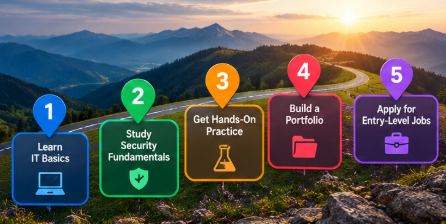
Step 1: Learn Basic IT Concepts
Start with computer hardware, operating systems, networking, and troubleshooting. If you already have IT experience, review any gaps in your knowledge.
Step 2: Study Security Fundamentals
Learn about common attacks, defensive controls, access management, and safe security practices. A structured introductory course can help organize your learning.
Step 3: Practise in a Legal Lab
Use a personal virtual machine, intentionally vulnerable training environment, or reputable cybersecurity learning platform. Practise analyzing logs, configuring basic security controls, and completing guided exercises.
Never scan, test, or attempt to access systems without authorization.
Step 4: Build a Small Portfolio
Document projects that demonstrate what you have learned. Examples include a home lab with basic network monitoring, a security checklist for a small website, or a written analysis of sample security logs.
Explain the goal, the tools used, what you observed, and how you would improve security. Do not publish passwords, private data, or sensitive system details.
Step 5: Consider an Entry-Level Certification
An introductory certification may help structure your learning and demonstrate foundational knowledge. Choose one that matches your budget, current experience, and target job requirements.
Do not assume that collecting certificates alone will make you job-ready. Practical skills and clear evidence of what you can do matter too.
Step 6: Apply for Relevant Junior Roles
Search for junior security analyst, SOC analyst trainee, IT support, help desk, and junior network support positions. Some candidates enter cybersecurity directly, while others first gain experience in general IT.
Tailor your resume to each role and include relevant projects, practical skills, and any applicable training.
Is Cybersecurity Difficult to Learn?
Cybersecurity can be challenging, particularly for people who have never worked with computers beyond everyday tasks. Networking, operating systems, security concepts, and technical troubleshooting take time to understand.
The difficulty depends on your starting point, learning routine, and chosen specialization. You do not need to know everything at once.
A beginner can make progress by studying one topic at a time, practising regularly, and reviewing mistakes. A consistent learning routine is usually more useful than trying to master several advanced tools in a short period.
You should also expect to keep learning after finding a job. New vulnerabilities, technologies, and attack methods require cybersecurity professionals to update their knowledge.
Pros and Cons of a Cybersecurity Career
Before choosing this field, consider both its advantages and its challenges.
Advantages
- Strong career potential: Some cybersecurity occupations have positive long-term employment projections.
- Variety of roles: You can explore security operations, cloud security, penetration testing, and other specializations.
- Meaningful work: Your work can help protect businesses, individuals, and important digital services.
- Professional development: Experience and specialization can open opportunities for more advanced responsibilities.
- Cross-industry demand: Organizations in many sectors need security expertise.
Disadvantages
- A demanding learning curve: Technical fundamentals and practical skills take time to develop.
- Competitive entry-level hiring: Some junior roles attract many applicants and require hands-on knowledge.
- Ongoing education: Security tools and threats change, so learning continues throughout your career.
- Potentially stressful incidents: Security teams may need to respond quickly when a serious incident occurs.
- Irregular hours in some roles: Certain incident response and security operations positions require on-call work or shift schedules.
Understanding these trade-offs will help you decide whether the work suits your interests and expectations.
Is Cybersecurity a Good Career for Beginners?
Cybersecurity can be a good long-term goal for beginners, but getting the first job may take preparation. Many security positions require some combination of IT knowledge, practical experience, certifications, or formal education.
If you are starting from zero, focus on learning networking, operating systems, basic scripting, and security principles. Build practical projects and explore entry-level opportunities rather than relying entirely on certificates.
A computer science or information technology degree can be helpful for certain employers, but requirements differ between positions. Some people enter through relevant training and hands-on experience, while others transition from technical support, networking, or system administration.
Your progress will depend on the time you invest, the quality of your practice, and the opportunities available in your target market.
Frequently Asked Questions
Is cybersecurity a good career in 2026?
Yes, it can be a strong career choice for people who enjoy technology, security, and problem-solving. However, job availability and requirements vary by location and experience.
Can I get a cybersecurity job without a degree?
Some employers accept relevant training, certifications, and practical experience instead of a degree. Others prefer or require formal education, so check the requirements for your target roles.
How long does it take to learn cybersecurity?
There is no fixed timeline. Your progress depends on your existing IT knowledge, study time, and chosen role. Building the skills needed for employment usually requires consistent study and practical experience.
Is cybersecurity hard for beginners?
It can be challenging, but beginners can make progress by learning networking, operating systems, and security fundamentals step by step. Regular practice helps turn theoretical knowledge into useful skills.
Which cybersecurity job is best for beginners?
There is no single best role for everyone. Junior SOC analyst, security analyst trainee, IT support, and network support positions may be useful starting points, depending on your skills and local job market.
Does cybersecurity pay well?
Some cybersecurity roles offer competitive salaries, especially with experience and specialization. Actual earnings depend on the country, employer, role, and skill level.
Do I need coding to work in cybersecurity?
Not every cybersecurity role requires advanced programming. However, basic scripting can be helpful, and specialized roles may require stronger programming skills.
Read More: Best Budget Laptops in 2026: Top Affordable Picks for Every Need
Final Verdict: Is Cybersecurity Worth It?
Cybersecurity can be a worthwhile career in 2026 if you are interested in technology, willing to solve complex problems, and prepared to keep developing your skills. The field offers multiple specializations, opportunities across industries, and encouraging employment projections for information security analysts in the United States.
However, success is not automatic. Beginners need realistic expectations, a strong technical foundation, hands-on practice, and a thoughtful approach to job applications.
Start with IT fundamentals, explore cybersecurity through legal training labs, build a portfolio, and research the requirements for roles in your target market. With consistent effort, you can determine whether cybersecurity is the right long-term career for you.
Career outlook and salary figures in this article are based on US Bureau of Labor Statistics data. Individual results vary by location, role, experience, and employer.