An AI chatbot is a software application that uses artificial intelligence to communicate with people through natural language. Instead of relying only on fixed buttons or pre-written replies, an AI chatbot can interpret a user’s question, understand its context, and generate a response.
Today, AI chatbots are used on websites, messaging platforms, customer-service systems, business applications, and many other digital services. Some can simply answer questions, while more advanced systems can retrieve information, connect with business tools, or help users complete specific tasks.
Understanding what an AI chatbot is, how it works, and what it can and cannot do is useful for anyone using AI technology at work, at home, or online.
What Is an AI Chatbot?
An AI chatbot is a computer program that uses artificial intelligence technologies to interact with users through text or voice conversations.
Modern AI chatbots commonly use technologies such as natural language processing (NLP), machine learning, and large language models (LLMs). These technologies allow a chatbot to interpret natural-language requests and produce responses that are not necessarily limited to a fixed set of pre-written answers.
For example, instead of selecting “Order Status” from a menu, a customer could type:
“Where is my order, and when should I expect it?”
An AI chatbot can interpret the request and, when connected to the appropriate business systems, retrieve relevant information and respond conversationally.

How Does an AI Chatbot Work?
An AI chatbot generally processes a conversation through several stages.
1. The user sends a message
The interaction starts when someone enters a question, instruction, or request. Depending on the system, the input may be text or voice.
For example:
“Can you explain how a VPN works?”
2. The system interprets the request
Natural language processing and related technologies help the system identify what the user is asking and understand relevant context.
Modern AI chatbots can handle different ways of expressing the same idea rather than depending entirely on exact keywords.
3. The AI generates or retrieves information
Depending on the chatbot’s design, it may generate a response using an AI model, retrieve information from a knowledge base, or use connected business systems.
Some systems combine these approaches. For example, a customer-service chatbot may use an AI model to understand a question while retrieving the actual account information from a company’s database.
4. The chatbot provides a response
The system then returns an answer in natural language. In a continuing conversation, it may also use information from earlier messages to maintain context.
More advanced chatbots can go beyond answering questions and help users perform tasks when they have access to the necessary tools or applications.

AI Chatbots vs. Traditional Chatbots
Not every chatbot uses artificial intelligence.
Traditional or rule-based chatbots usually follow predefined conversation flows. They may recognize specific commands, keywords, buttons, or menu selections and then provide a programmed response.
AI chatbots are more flexible because they can use machine learning, natural language technologies, and language models to interpret a broader range of requests.
| Feature | Traditional Chatbot | AI Chatbot |
|---|---|---|
| Responses | Mostly predefined | Can generate responses |
| Conversation | Usually structured | More flexible |
| Natural language | Limited | Generally stronger |
| Context | Often limited | Can maintain conversational context |
| Complex questions | More difficult | Better suited to open-ended requests |
| External tools | Possible | Common in advanced systems |
A rule-based chatbot can still be useful for predictable tasks. For example, a business might use one to answer opening-hours questions or guide customers through a fixed support process.
What Technologies Power AI Chatbots?
Several technologies can work together inside an AI chatbot.
Natural Language Processing
Natural language processing (NLP) helps computers process and interpret human language. It is an important part of conversational AI because users do not always phrase the same request in exactly the same way.
Machine Learning
Machine learning allows systems to identify patterns in data and improve their ability to perform particular tasks.
Large Language Models
Many modern AI chatbots use large language models (LLMs). These models are trained to recognize patterns in language and generate text based on the input they receive.
Generative AI
Generative AI allows a chatbot to produce new responses rather than selecting only from a fixed collection of scripted answers.
These technologies do not necessarily operate independently. A modern chatbot can combine language understanding, an LLM, business data, retrieval systems, and other software components in one application.
What Are AI Chatbots Used For?
AI chatbots can be used in many different situations.
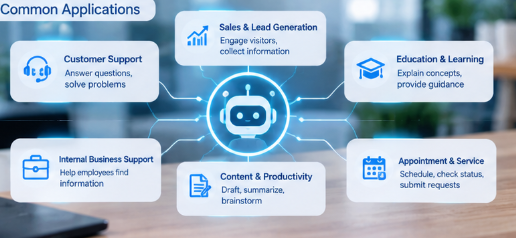
Customer Support
Businesses can use chatbots to answer common questions, explain products, troubleshoot basic issues, and guide customers toward appropriate support.
Sales and Lead Generation
A chatbot can answer questions about products or services, collect basic information from potential customers, and help visitors find relevant offerings.
Internal Business Support
Companies can use AI chatbots to help employees find information in internal documentation, policies, or knowledge bases.
Education and Learning
Students can use conversational AI tools to ask for explanations, examples, summaries, and help understanding difficult concepts.
Content and Productivity
AI chatbots can assist with tasks such as drafting text, brainstorming ideas, summarizing information, explaining concepts, and helping with certain programming tasks.
Appointment and Service Assistance
When integrated with business systems, a chatbot can help users schedule appointments, check information, submit requests, or begin other service processes.
The actual capabilities vary considerably between systems.
What Are the Benefits of AI Chatbots?
AI chatbots can provide several practical benefits.
- Faster responses: Users can receive answers without always waiting for a human representative.
- 24/7 availability: Automated systems can operate outside normal business hours.
- Scalability: One chatbot can handle many conversations simultaneously.
- Natural interaction: Users can communicate using ordinary language rather than learning a complicated interface.
- Automation: Repetitive questions and routine processes can be handled automatically.
- Accessibility to information: Chatbots can provide a conversational way to search or interact with knowledge bases.
For businesses, these capabilities can help automate routine interactions and support human employees rather than necessarily replacing every human interaction.
What Are the Limitations of AI Chatbots?
AI chatbots are useful, but they are not automatically accurate or reliable in every situation.
An AI chatbot can produce an answer that sounds convincing while still being incorrect. The quality of its response depends on factors such as the underlying model, available information, system design, and the complexity of the request.
There can also be privacy and security considerations, particularly when a chatbot processes sensitive information or connects to external systems. Organizations deploying AI systems need to consider appropriate risk-management and security practices. NIST’s AI Risk Management Framework and its Generative AI Profile provide frameworks for identifying and managing AI-related risks.
For important decisions, users should verify critical information against reliable sources instead of treating an AI chatbot’s response as automatically authoritative.
AI Chatbot vs. AI Assistant vs. AI Agent
These terms are related, but they are not always interchangeable.
An AI chatbot primarily provides conversational interaction and answers questions or assists with specific tasks.
An AI assistant generally has a broader role. It may help with multiple types of tasks, such as writing, scheduling, information retrieval, or working with applications.
An AI agent is generally designed to take a more active role in accomplishing a goal. Depending on its design, an agent can plan steps, use tools, interact with software, and perform multi-step workflows.
The boundaries can overlap because modern AI products increasingly combine chatbot, assistant, and agent capabilities.
Examples of AI Chatbots
Several well-known AI products demonstrate different approaches to conversational AI.
ChatGPT is a conversational AI system that can respond to follow-up questions and assist with a wide range of tasks.
Other AI chatbot and conversational-AI systems are offered by technology companies for consumer use, customer service, workplace assistance, and application development.
For businesses, an AI chatbot does not necessarily have to be a general-purpose public chatbot. It can be designed around a company’s own documentation, products, services, or customer-support workflows.
Are AI Chatbots Always Accurate?
No. AI chatbots can make mistakes, including producing incorrect or incomplete information.
This is particularly important when a chatbot is used for medical, legal, financial, security, or other high-impact information. The appropriate level of verification depends on the subject and consequences of an incorrect answer.
A useful approach is to treat an AI chatbot as a tool for obtaining information or assistance while independently verifying important claims through authoritative sources.
Frequently Asked Questions
What is an AI chatbot in simple words?
An AI chatbot is a computer program that can communicate with people using natural language. It uses artificial intelligence to understand requests and produce conversational responses.
What is the difference between a chatbot and an AI chatbot?
A traditional chatbot usually follows predefined rules or conversation flows. An AI chatbot uses artificial intelligence technologies to interpret natural-language requests and can generate more flexible responses.
Can an AI chatbot understand human language?
AI chatbots can process and interpret human language using technologies such as natural language processing and language models. However, understanding is not perfect, and the system can misunderstand a request or generate an incorrect response.
Can an AI chatbot replace human customer service?
An AI chatbot can automate many routine customer-service interactions, but it does not automatically replace human support. Complex, sensitive, or unusual cases may still require a human representative.
Can AI chatbots access company data?
They can when they are specifically integrated with authorized databases, knowledge bases, applications, or other information sources. Access depends on the chatbot’s design and permissions.
Are AI chatbots safe to use?
Safety depends on the specific system, its implementation, the information being shared, and how its outputs are used. Users should avoid unnecessarily sharing sensitive information and verify important information before relying on it.