Generative AI is a type of artificial intelligence that can create new content from a user’s prompt or instructions. It can generate text, images, audio, video, software code, and other digital content. Unlike AI systems that mainly classify information or make predictions, generative AI focuses on creating new outputs based on patterns it learned from large datasets.
Today, people use generative AI for writing, research, software development, design, customer support, education, and many other tasks. However, understanding what generative AI actually does is important before relying on it. So, let’s look at how the technology works, what it can create, where people use it, and what limitations users should consider.
What Is Generative AI?
Generative AI, often called GenAI, refers to AI models that learn patterns and relationships from training data and then use those patterns to generate new content.
For example, you can give a generative AI tool a prompt such as:
“Write a 500-word explanation of how solar panels work.”
The system can then generate a new response based on the instructions and the patterns it learned during training.
Similarly, an image-generation model can turn a written description into an image, while an AI coding assistant can generate code from a natural-language request.
The key idea is simple: generative AI creates content in response to an input rather than simply retrieving a prewritten response from a database. NIST describes generative AI as a class of AI models that generates derived synthetic content such as text, images, video, and audio.

How Does Generative AI Work?
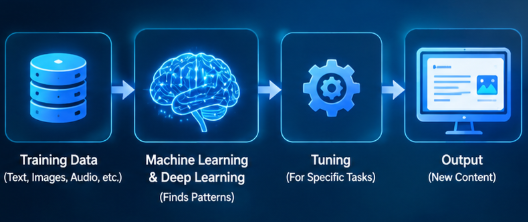
Generative AI systems use machine learning and deep learning models to learn patterns from large datasets. Although different models use different techniques, the overall process usually involves training, tuning, and generation.
1. Training the AI Model
First, developers train an AI model using large amounts of data. Depending on the model, that data may include text, images, audio, video, code, or several types of information.
During training, the model learns relationships and patterns within the data. For example, a language model learns how words and pieces of text relate to one another. Image models learn patterns related to visual information.
This training creates a foundation model that can support many different applications. Large language models, or LLMs, represent one important category of foundation models used for text-based generative AI.
2. Tuning the Model
Next, developers can tune a general-purpose model for a particular task or application.
For example, a company might adapt a model for customer support, coding assistance, document analysis, or another specialized workflow.
Tuning can help the model perform better for a specific purpose. However, developers may also use other techniques, such as prompting or grounding, depending on the application’s requirements.
3. Generating the Output
Finally, the user provides a prompt or another type of input.
The model processes that input and generates an output based on patterns and relationships it learned during training. For language models, the system predicts likely next tokens within the context of the prompt and previous output.
As a result, the same model can generate different responses to different instructions.
What Can Generative AI Create?
Generative AI can work with several types of content. The exact capabilities depend on the model and the application.
Text
Text-generation systems can help users create:
- Articles and reports
- Emails and business documents
- Summaries
- Product descriptions
- Brainstorming ideas
- Explanations
- Translations
- Conversational responses
For instance, a writer can use generative AI to create an initial outline and then edit the content manually.
Images
Image-generation models can create images from natural-language descriptions. Users can also apply some models to image editing, transformation, and enhancement tasks.
Audio and Speech
Generative AI can create or transform speech, music, and other audio. Businesses can use these capabilities for voice assistants, narration, accessibility tools, and creative projects.
Video
Video-generation systems can create or transform video content from prompts or other inputs. This area continues to develop quickly, so capabilities can vary considerably between models and products.
Computer Code
Generative AI can generate code, explain existing code, suggest improvements, translate code between programming languages, and help developers prototype software. Developers should still review and test generated code before using it in production.
Generative AI vs. Traditional AI
Generative AI and traditional AI can solve different types of problems.
Traditional AI often focuses on tasks such as classification, prediction, detection, recommendation, or decision support. For example, a spam-detection system can classify an email as spam or legitimate.
Generative AI, on the other hand, focuses on creating new content based on an input.
| Traditional AI | Generative AI |
|---|---|
| Often classifies or predicts | Generates new content |
| Detects patterns for a specific task | Learns patterns and uses them to create outputs |
| Example: spam detection | Example: generating an email |
| Example: fraud detection | Example: generating an image |
However, these categories can overlap. A modern application may use traditional AI techniques and generative AI together. Google Cloud, for example, describes situations where developers can use generative AI, traditional AI, or a combination of both depending on the task.
Common Uses of Generative AI
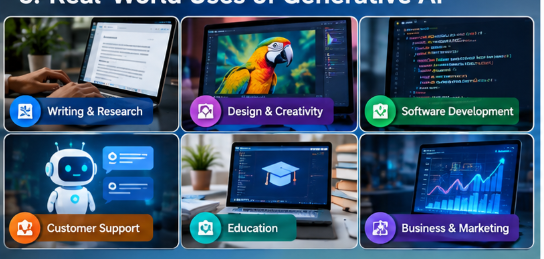
Generative AI now supports a wide range of practical tasks.
Business and Productivity
Businesses can use generative AI to draft documents, summarize information, create internal content, support customer-service workflows, and assist employees with routine tasks.
As a result, teams can spend less time on repetitive work and more time reviewing, improving, and making decisions.
Education
Students and educators can use generative AI to explain difficult concepts, create practice questions, summarize material, and brainstorm ideas.
However, users should verify important information because generative AI can produce incorrect answers.
Software Development
Developers can use AI coding tools to generate code, explain programming concepts, write tests, debug problems, and create prototypes.
Therefore, generative AI can act as a development assistant rather than a complete replacement for software engineering judgment.
Marketing and Content Creation
Marketers can use generative AI for brainstorming, outlines, first drafts, product descriptions, image concepts, and other creative tasks.
Even so, human review remains important when content needs strong factual accuracy, brand consistency, or original insight.
Research and Data Work
Researchers can use generative AI for tasks such as summarization, idea generation, data-related workflows, and synthetic-data applications. Some specialized systems also support scientific and pharmaceutical research.
What Are the Benefits of Generative AI?
Generative AI offers several potential benefits when people use it appropriately.
Faster Content Creation
AI can create a first draft quickly. Therefore, writers and teams can spend more time editing, checking facts, and improving the final result.
Better Productivity
Generative AI can help automate or accelerate repetitive tasks. This can reduce the time people spend on activities such as summarization, drafting, and basic content transformation.
Faster Brainstorming
AI can produce multiple ideas, approaches, or variations within seconds. As a result, it can help people overcome creative blocks and explore different possibilities.
Personalized Assistance
Generative AI can adapt its responses to different prompts and contexts. This makes it useful for tasks ranging from tutoring and writing support to coding assistance.
However, these benefits depend on the quality of the model, the instructions, the available information, and the level of human oversight.
What Are the Limitations of Generative AI?
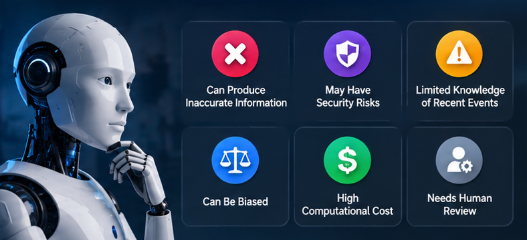
Generative AI has powerful capabilities, but it also has important limitations.
AI Can Produce Incorrect Information
A generative AI model can produce an answer that sounds convincing but contains factual errors. People often call these errors “hallucinations.”
Therefore, users should verify important claims with reliable sources instead of assuming that every AI-generated answer is correct.
AI Can Reflect Bias
Models learn from data, and that data can contain biases or gaps. Consequently, AI-generated outputs can sometimes reflect those limitations.
Developers and organizations need to evaluate models carefully, especially when they use AI in sensitive or high-impact situations.
Privacy Requires Careful Attention
Users should think carefully before entering confidential, personal, or sensitive information into an AI service.
Organizations should also establish clear policies for data handling, access, security, and acceptable AI use.
Copyright and Legal Questions
Generative AI has raised ongoing questions about training data, copyrighted material, ownership, and the use of generated content.
The legal rules can vary by jurisdiction and continue to evolve. Therefore, businesses should obtain appropriate legal advice when copyright or other legal issues create significant risk.
Synthetic Media Can Create New Risks
Generative AI can create realistic text, images, audio, and video. Consequently, people can use the same technology for both legitimate creative work and misleading synthetic media.
NIST has identified several risks associated with generative AI and provides guidance for organizations that want to manage those risks.
Is Generative AI the Same as ChatGPT?
No. Generative AI describes a broad category of technology, while ChatGPT is an application that uses generative AI models.
Generative AI includes systems that generate text, images, audio, video, code, and other content. ChatGPT focuses primarily on conversational interaction, although modern AI applications can support multiple types of input and output.
Therefore, it is more accurate to think of ChatGPT as one example of an application that uses generative AI rather than treating the two terms as synonyms.
What Is Multimodal Generative AI?
Multimodal generative AI can work with more than one type of information, such as text, images, audio, video, or code.
For example, a multimodal system may accept an image and a written question, analyze both, and generate a text response. Some modern models can also generate different forms of content from natural-language instructions.
This capability makes generative AI useful for applications that require several forms of information at the same time.
What Is the Future of Generative AI?
Generative AI continues to develop across software, business, education, research, media, and other industries.
Developers are improving model capabilities, multimodal processing, AI assistants, coding tools, grounding techniques, and model customization. At the same time, organizations are paying greater attention to accuracy, privacy, security, copyright, bias, and responsible deployment.
As these systems become more capable, human judgment will remain important. AI can generate content quickly, but people still need to decide whether that content is accurate, appropriate, useful, and suitable for the intended purpose.
Frequently Asked Questions
What is generative AI in simple terms?
Generative AI is a type of artificial intelligence that creates new content from prompts or other inputs. It can generate text, images, audio, video, code, and other digital content.
How does generative AI learn?
Generative AI models learn patterns and relationships from large datasets during training. The model then uses those learned patterns to generate outputs based on new inputs.
What are some examples of generative AI?
Examples include AI chatbots, image-generation tools, AI coding assistants, speech-generation systems, and video-generation applications.
Can generative AI replace human workers?
Generative AI can automate or assist with some tasks, but it does not automatically replace an entire job. Its usefulness depends on the task, the industry, the quality of the system, and the amount of human oversight required.
Is generative AI always accurate?
No. Generative AI can produce inaccurate or misleading information. Therefore, users should verify important facts with reliable and authoritative sources.
Why is generative AI important?
Generative AI can help people create content, analyze information, write software, brainstorm ideas, and automate parts of many workflows. Its impact depends on how organizations and individuals use the technology and manage its limitations.