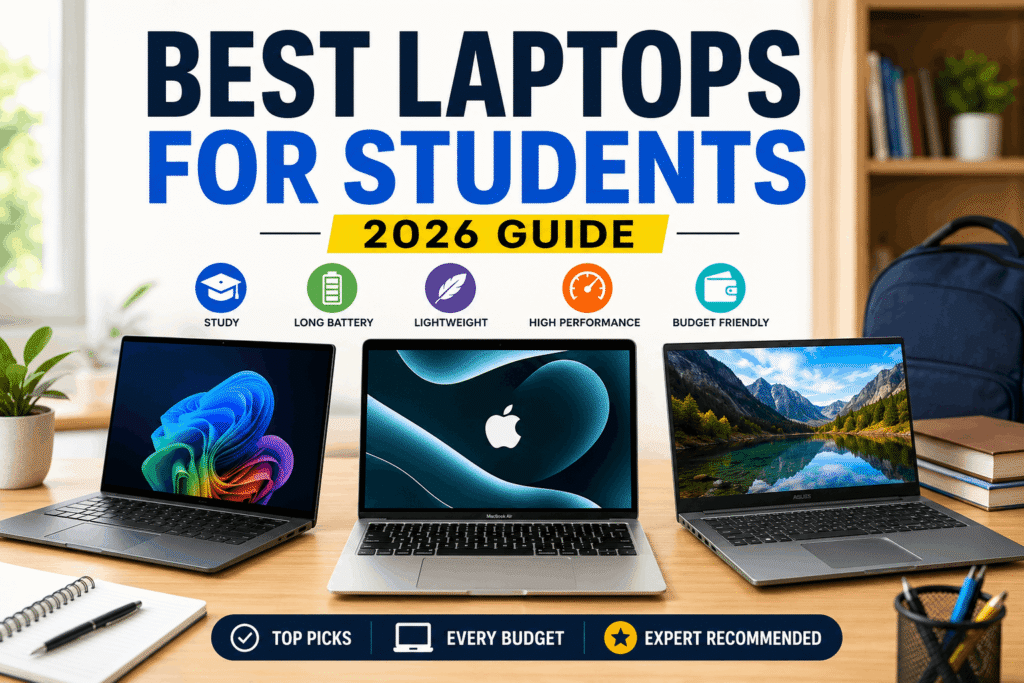
If you are looking for the best laptops for writers in 2026, you do not necessarily need the most powerful laptop you can buy. Writers usually spend far more time typing, researching, reading, editing, and working with browser tabs than running demanding graphics or video applications.
That changes what matters when choosing a laptop.
A comfortable keyboard, sharp and readable display, long battery life, quiet operation, portability, and enough memory for everyday multitasking can make a much bigger difference to a writer than having the fastest processor available.
In this guide, we look at some of the best laptops for writers in 2026 and explain what to look for before buying one. The recommendations cover different types of writers, including novelists, bloggers, students, journalists, copywriters, and freelance writers.
What Makes a Laptop Good for Writing?
The best writing laptop is not simply the one with the highest specifications. It is the laptop that remains comfortable and reliable after several hours of typing.
For most writers, these are the features that deserve the most attention:
- Comfortable keyboard
- Clear, easy-to-read display
- Long battery life
- Lightweight design
- Quiet operation
- At least 16GB of RAM for comfortable multitasking
- Fast SSD storage
- Reliable Wi-Fi
- A processor that can handle documents, research, and multiple browser tabs
Writing itself is not especially demanding. However, a typical writing session may involve Google Docs or Microsoft Word, research tabs, email, cloud storage, grammar tools, music, and communication apps all running at once.
That is why a balanced laptop is usually more useful than an unnecessarily powerful one. Independent laptop testing guidance similarly emphasizes that writers generally benefit more from portability and overall user experience than from maximum CPU performance.
How to Choose the Best Laptops for Writers in 2026
Here are several laptop families worth considering when shopping for a writing-focused machine:
| Laptop | Best For | Main Strength |
|---|---|---|
| Apple MacBook Air | Most writers | Battery life, portability, quiet operation |
| Microsoft Surface Laptop | Windows writers | Comfortable productivity experience |
| Lenovo ThinkPad X1 Carbon | Heavy typists | Keyboard and business-focused design |
| ASUS Zenbook 14 OLED | Writers who value the display | OLED screen and portability |
| LG Gram | Large-screen writers | Big display with a lightweight design |
| Chromebook Plus | Budget writers | Simple browser-based writing |
| Lenovo Yoga series | Flexible users | 2-in-1 versatility |
Exact configurations, availability, and prices can change, so check the current configuration before purchasing.
1. Apple MacBook Air — A Strong Choice for Most Writers
The MacBook Air is a natural fit for writers who want a thin, quiet laptop with a strong combination of portability, battery life, and everyday performance.
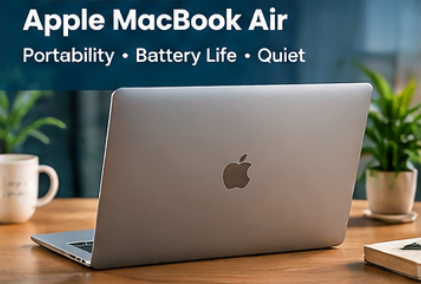
The current M5 generation is available in compact and larger-screen configurations, giving writers a choice between maximum portability and additional screen space. Current 2026 writing-focused guides frequently highlight the MacBook Air because writing workloads do not require workstation-level processing power.
For many people, the MacBook Air is one of the best laptops for writers in 2026 because of its balance of portability, battery life, and performance.
Why writers may like it
- Excellent portability
- Quiet operation
- Strong battery life
- Comfortable keyboard
- Sharp display
- Good performance for writing and research
- Available in different screen sizes
The main downside is price. A MacBook Air can cost more than a basic Windows laptop that can technically perform the same writing tasks.
For authors, bloggers, and professionals who spend many hours working away from a desk, however, portability and battery life can justify the additional cost.
2. Microsoft Surface Laptop — A Premium Windows Option
Writers who prefer Windows may want to consider the Microsoft Surface Laptop.
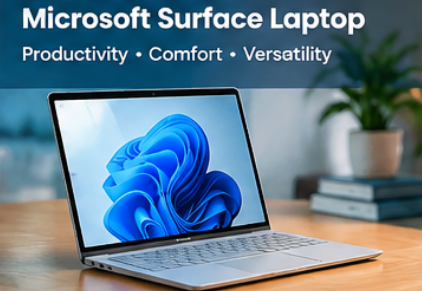
It combines a relatively lightweight design with a comfortable keyboard and a screen designed for everyday productivity. It is particularly suitable for people who use Microsoft Word, Microsoft 365, OneDrive, browser-based research tools, and other Windows applications.
The Surface Laptop is also worth considering if you want a traditional laptop rather than a detachable tablet.
Why choose it?
The biggest advantage is the combination of Windows compatibility and a premium portable design.
It can work well for:
- Freelance writers
- Students
- Bloggers
- Business writers
- Copywriters
- Remote workers
Before buying, check whether the specific Windows-on-ARM configuration supports every application you depend on. Compatibility can matter more than raw performance when your workflow includes specialized desktop software.
3. Lenovo ThinkPad X1 Carbon — For People Who Type All Day
For heavy typists, the ThinkPad X1 Carbon can be considered among the best laptops for writers in 2026.

ThinkPad laptops have long been associated with business productivity and comfortable keyboards. Current 2026 models continue that focus, with recent coverage highlighting the keyboard, durability, connectivity, and business-oriented design.
This can make the X1 Carbon particularly attractive to writers who type thousands of words every week.
Best suited for
- Professional writers
- Journalists
- Editors
- Freelancers
- Business users
- People who prioritize keyboard feel
It is not necessarily the right choice for someone looking for the cheapest possible laptop. But if you spend most of your working day typing, keyboard quality can be worth prioritizing over specifications that you may never use.
4. ASUS Zenbook 14 OLED — Great for Writers Who Read a Lot
If screen quality is a major priority, the Zenbook 14 OLED is another option to consider when comparing the best laptops for writers in 2026.
That makes display quality important.

The ASUS Zenbook 14 OLED is an interesting option for writers who want a compact machine with a high-quality OLED display. Models in the Zenbook family combine portable designs with high-resolution screens and modern processors.
An excellent display can be particularly useful for:
- Research-heavy writing
- Editing
- Content marketing
- Academic work
- Reading long documents
- Working with images alongside text
Keep in mind that OLED screens can consume more power in some usage scenarios, and the exact battery experience depends on the configuration and workload.
5. LG Gram — For Writers Who Want a Bigger Screen
Some writers simply work better with more screen space.
If you regularly keep a research document open beside your draft, a larger laptop can reduce the need to constantly switch between windows.
LG Gram models are designed around large displays while keeping weight relatively low. Current 2026 laptop guides continue to include large-screen lightweight models for people who want more workspace without carrying a heavy machine.
A larger screen can be especially useful for:
- Editors
- Researchers
- Screenwriters
- Content managers
- Writers who use split-screen workflows
The trade-off is obvious: a 16-inch laptop takes up more physical space than a compact 13- or 14-inch model.
6. Chromebook Plus — A Budget-Friendly Writing Option
Not every writer needs Windows or macOS.
If your workflow is mainly Google Docs, Google Drive, Gmail, browser research, and web-based tools, a Chromebook Plus can be a practical alternative.
Chromebooks are particularly attractive when simplicity and price matter more than access to traditional desktop applications.
A Chromebook can work well if you:
- Write mainly in Google Docs
- Store files in the cloud
- Use browser-based SEO tools
- Research online
- Want a simple computer
- Have a limited budget
However, ChromeOS can be limiting if you rely on desktop-only applications. For example, writers who depend on particular versions of professional writing software should verify compatibility before buying.
How Much RAM Does a Writer Need?
For basic writing, you do not need huge amounts of RAM.
However, 16GB RAM is a sensible target for a new laptop if you want comfortable multitasking and several years of useful life.
For example, a writer might have:
- Microsoft Word
- 15 browser tabs
- Google Docs
- Spotify
- Grammarly
- Research PDFs
- Cloud storage
open at the same time.
Eight gigabytes can still be enough for lighter workloads, but 16GB gives you more breathing room.
If you also edit videos, work with large images, develop software, or use demanding AI applications locally, moving to 32GB can make more sense.
How Much Storage Does a Writer Need?
For ordinary writing, 256GB can technically be enough.
But for a new laptop, 512GB SSD storage is a more comfortable target.
A 512GB SSD gives you room for:
- Documents
- Photos
- PDFs
- Research material
- Apps
- Local backups
- Personal files
An SSD also makes the computer feel much faster during startup and everyday file operations than an older mechanical hard drive.
If most of your documents live in cloud storage, you may not need a huge internal drive.
Does a Writer Need a Powerful Processor?
Usually, no.
Microsoft Word, Google Docs, web browsing, email, and research do not require the same processing power as video editing or 3D rendering.
Instead of spending most of your budget on the fastest processor available, consider putting more emphasis on:
- Keyboard comfort
- Battery life
- Display quality
- Weight
- RAM
- SSD storage
- Build quality
A modern mid-range processor is already more than capable of handling normal writing work.
The situation changes if your writing workflow also includes video editing, programming, large data analysis, local AI models, or other demanding workloads.
What Type of Keyboard Is Best for Writers?
Keyboard comfort is one of the most important things to consider.
Look for:
- Comfortable key travel
- Consistent key response
- Good spacing
- A layout you already understand
- Backlighting if you write at night
- A solid keyboard deck
- Quiet keys if you work around other people
There is no single keyboard that feels perfect for everyone.
If possible, physically try the laptop before buying it. A specification sheet cannot tell you whether a keyboard will feel comfortable after two or three hours of typing.
Is Battery Life Important for Writers?
Yes.
A writer may work in a coffee shop, library, university, train, airport, or shared workspace. Having to search for a power outlet every few hours can interrupt your workflow.
Battery claims should also be compared carefully because manufacturers may use different testing methods. Current writing-laptop comparisons specifically warn that advertised battery figures are not always directly comparable between brands.
What Screen Size Is Best for Writing?
There is no universal answer.
13–14 inches
Best if portability matters.
You can easily carry the laptop between home, office, university, and coffee shops.
15–16 inches
Better if you prefer a larger workspace.
A bigger screen is useful for split-screen research, editing, spreadsheets, and long documents.
For most mobile writers, 14 inches is a useful middle ground.
Do Writers Need a Dedicated Graphics Card?
Usually not.
A dedicated GPU is unnecessary for ordinary writing.
Integrated graphics are generally sufficient for:
- Word processing
- Web browsing
- Streaming
- Research
- Video calls
- Basic photo editing
A dedicated GPU becomes relevant if your work also includes gaming, professional video editing, 3D applications, advanced graphics work, or certain local AI workloads.
Best Laptop Specifications for Writers in 2026
These specifications provide a useful starting point when comparing the best laptops for writers in 2026.
Budget writing laptop
- 8GB RAM minimum
- 256GB SSD
- Modern entry-level processor
- Full HD or better display
Recommended writing laptop
- 16GB RAM
- 512GB SSD
- Modern mid-range processor
- High-quality 13–15 inch display
- Good keyboard
- Strong battery life
Heavy multitasking
- 32GB RAM
- 512GB–1TB SSD
- Faster modern processor
- Larger high-quality display
You do not need the most expensive configuration simply because a laptop has a higher processor number.
Which Laptop Is Best for Different Types of Writers?
Different writers have different priorities.
Novelists and authors
Prioritize keyboard comfort, battery life, quiet operation, and a display that is comfortable for long sessions.
Bloggers and content writers
Look for a good balance of keyboard quality, portability, browser performance, and battery life. Since research often means many browser tabs, RAM becomes more important.
Students
Portability, battery life, price, and durability are usually important. A lightweight 13- or 14-inch laptop can be convenient for carrying between classes.
Freelance writers
A reliable keyboard, strong battery, webcam, microphone, and good multitasking performance can be more valuable than gaming-level hardware.
Journalists
Portability, keyboard quality, battery life, connectivity, and a good webcam can matter when working away from a traditional office.
How to Choose the Best Laptop for You
Before buying, ask yourself five simple questions:
1. How many hours do I type every day?
If you type for several hours, prioritize the keyboard.
2. Do I travel with my laptop?
If yes, choose a lighter 13- or 14-inch machine.
3. Do I work with many browser tabs?
If yes, aim for 16GB RAM.
4. Do I need special software?
Check Windows, macOS, or ChromeOS compatibility before buying.
5. What is my actual budget?
Do not spend money on performance you will never use.
Frequently Asked Questions
What is the best laptop for writers?
The best laptops for writers in 2026 depend on your operating system preference, budget, typing habits, portability needs, and software.
How much RAM does a writer need?
For a new laptop, 16GB RAM is a comfortable target for most writers. Eight gigabytes can handle basic writing, while 32GB is more appropriate for heavy multitasking or demanding workloads.
Is a MacBook good for writers?
Yes. MacBooks are popular for writing because they combine a comfortable keyboard, strong battery life, portable designs, and quiet operation. However, Windows may be preferable if your workflow depends on Windows-only software.
Are Chromebooks good for writers?
Chromebooks can be excellent for writers whose work is mostly browser-based, especially Google Docs and online research. They are less suitable when you require desktop applications that are unavailable on ChromeOS.
Do writers need a gaming laptop?
Usually not. Gaming laptops often provide much more graphics performance than writing requires. They can make sense if writing is only one part of your workload and you also play games or use demanding creative software.
What should I prioritize when buying a writing laptop?
Start with the keyboard, screen, battery life, portability, RAM, and SSD storage. After those factors are covered, consider processor performance and other extras.
Final Thoughts
The best laptops for writers are not necessarily the laptops with the biggest specifications or highest prices.
For most writers, the better approach is to build a balanced setup around the way you actually work. A comfortable keyboard can make thousands of daily keystrokes easier. A clear display can make long editing sessions more pleasant. Good battery life lets you work away from an outlet, while a lightweight design makes the laptop easier to carry.
For many people, a modern laptop with 16GB RAM, a 512GB SSD, a quality display, a comfortable keyboard, and strong battery life is already more than enough for writing, research, and everyday productivity.
The right choice ultimately depends on your budget and workflow. Think about where you write, how many hours you type, which applications you use, and whether portability or screen size matters more to you. Once those requirements are clear, choosing the right laptop becomes much easier.