Artificial intelligence is becoming part of everyday life, but not every AI system works in the same way. Some AI tools simply answer questions or generate content when you give them a prompt. An AI agent can go a step further by understanding a goal, deciding what needs to be done, and taking actions to complete a task.
So, what is an AI agent exactly? In simple terms, an AI agent is a software system that can perceive information, make decisions, use available tools, and perform tasks with some level of independence. Instead of waiting for a person to tell it every individual step, an AI agent can determine the next step based on the goal it has been given.
This makes AI agents useful for many activities, from customer support and research to business automation, software development, and personal productivity.
What Is an AI Agent?
An AI agent is an artificial intelligence system designed to work toward a specific goal. It can take information from its environment, understand the situation, reason about possible actions, and then perform an action based on its objective.
For example, imagine you ask an AI agent to find three suitable hotels for a business trip. A basic AI chatbot might tell you how to search for hotels. An AI agent, depending on the tools and permissions available to it, could search hotel information, compare options, organize the results, and present the choices to you.
The important difference is that an AI agent is not only generating an answer. It is designed to take steps toward completing a task.
How Does an AI Agent Work?
Although AI agents can be built in different ways, most follow a basic process. They receive information, understand the goal, decide what to do, take an action, and then evaluate the result.
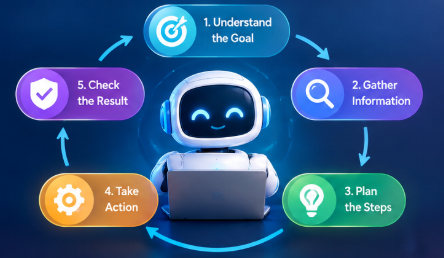
1. Understanding the Goal
First, the AI agent needs to understand what the user wants to accomplish. The goal could be something simple, such as organizing information, or something more complicated, such as researching a topic and preparing a report.
2. Gathering Information
The agent may need information before it can act. Depending on its design, it can use documents, databases, websites, APIs, or other connected tools to collect relevant information.
3. Reasoning and Planning
After gathering information, the agent determines what actions may help achieve the goal. It can break a larger task into smaller steps and decide which step should come next.
4. Taking Action
This is one of the most important characteristics of an AI agent. Instead of only producing text, an agent can sometimes interact with external tools. For example, it may create a document, update a database, run code, send information through an approved system, or perform another permitted action.
5. Checking the Result
Some AI agents can examine the result of an action and decide whether another step is necessary. This creates a cycle in which the agent continues working until the task is completed, reaches a limit, or requires human input.
AI Agent vs AI Chatbot
AI agents and AI chatbots can look similar because both can communicate with users, but their roles can be different.
A traditional chatbot is generally designed to respond to a user’s messages. For example, you might ask a chatbot a question and receive an answer immediately.
An AI agent can be designed to work toward a broader objective. Instead of simply answering a question, it may plan several steps, use tools, evaluate results, and continue working toward the requested outcome.
However, the line between chatbots and agents is not always strict. Modern AI systems can combine conversational interfaces with agent-like capabilities.
What Are the Main Parts of an AI Agent?
An AI agent usually combines several components that allow it to understand information and perform tasks.
- AI model: Provides language understanding, reasoning, or other intelligence.
- Instructions: Define what the agent should do and how it should behave.
- Tools: Allow the agent to interact with external systems or perform specific operations.
- Memory or context: Helps the system keep track of relevant information.
- Planning: Helps break complex goals into smaller actions.
- Feedback: Allows the agent to use results from previous actions when deciding what to do next.
Examples of AI Agents
AI agents can be used in many different areas. Here are some simple examples.
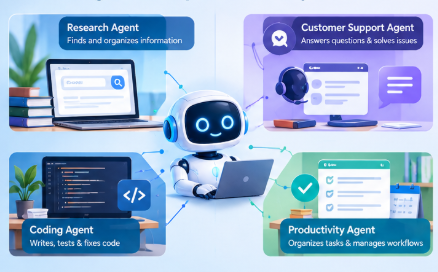
Customer Service Agent
A customer service AI agent can understand a customer’s request, search a company’s knowledge base, check relevant information, and help resolve common issues. More advanced systems may also work with business software when appropriate permissions are provided.
Research Agent
A research agent can help investigate a topic by collecting information from available sources, organizing findings, comparing information, and preparing a structured summary.
AI Coding Agent
A coding agent can help developers understand code, identify problems, write or modify files, run tests, and troubleshoot errors. The exact capabilities depend on the tools and permissions provided to the agent.
Personal Productivity Agent
A productivity agent could help organize tasks, summarize information, prepare documents, or manage parts of a workflow. These systems can be particularly useful when a task involves several repetitive steps.
Business Automation Agent
Businesses can use AI agents to automate parts of workflows such as processing information, routing requests, preparing reports, or assisting employees with repetitive operations.
What Is the Difference Between AI and an AI Agent?
Artificial intelligence is a broad field that includes systems capable of performing tasks that normally require human intelligence, such as understanding language, recognizing patterns, generating content, or making predictions.
An AI agent is a particular type of AI-based system designed to work toward a goal and potentially take actions. In other words, AI is the broader concept, while an AI agent is an application of AI that can be designed to act on a user’s behalf.
What Are the Benefits of AI Agents?
AI agents can provide several practical benefits when they are designed and deployed correctly.
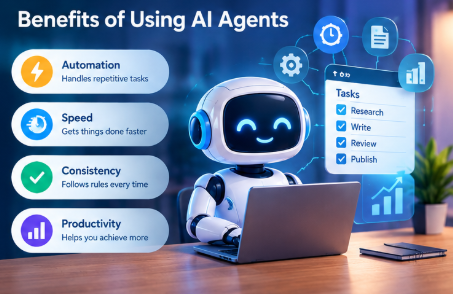
Automation
AI agents can handle multi-step tasks that would otherwise require a person to perform each step manually.
Speed
An agent can process information and perform repetitive operations quickly, which can reduce the time required for certain workflows.
Scalability
Businesses can use AI agents to support large volumes of routine requests without requiring every request to be handled manually from beginning to end.
Consistency
When an agent follows clearly defined instructions and processes, it can perform repetitive tasks using a consistent workflow.
24/7 Availability
Software-based AI agents can operate outside normal working hours, making them useful for services that need continuous availability.
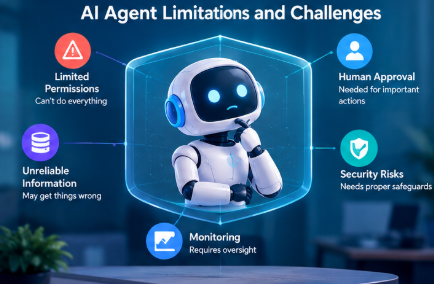
What Are the Limitations of AI Agents?
AI agents are powerful, but they are not perfect. An agent can misunderstand instructions, make incorrect assumptions, use unreliable information, or take an unsuitable action if its tools and safeguards are not properly designed.
For this reason, important workflows should include appropriate permissions, monitoring, testing, and human oversight. An AI agent should not automatically be trusted with sensitive or high-impact actions simply because it can perform them.
Are AI Agents Fully Autonomous?
Not necessarily. The word “autonomous” can make AI agents sound more independent than they actually are.
Some agents can complete several steps without human intervention, while others require approval before performing important actions. The level of autonomy depends on the system’s design, available tools, permissions, safety controls, and the task itself.
A well-designed AI agent can therefore be thought of as a system that operates within boundaries rather than as an independent human replacement.
How Are AI Agents Used in Business?
Companies are exploring AI agents for a wide range of workflows. An agent might help employees find information, process routine requests, analyze documents, assist customers, or coordinate steps across different software systems.
For example, a business could create an internal AI agent that receives an employee’s question, searches approved company documents, finds the relevant information, and provides an answer. A more advanced setup could also take an approved action in a connected business application.
The most useful applications are usually those where the task has a clear objective, defined rules, and measurable results.
What Is an AI Agent Used For?
AI agents can be used for many tasks, including:
- Customer support
- Research and information gathering
- Content and document workflows
- Software development
- Data processing
- Business process automation
- Task management
- Internal company assistance
- Workflow monitoring
- Personal productivity
What Is an AI Agent in Simple Words?
If you want the simplest possible explanation, think of an AI agent as a digital worker that is given a goal instead of a single question.
A normal AI tool might answer, “Here is how you can do this.” An AI agent may be designed to understand the goal, decide which steps are needed, use its available tools, and work through those steps.
It does not mean that the agent can do everything by itself. Its capabilities are limited by the AI model, tools, permissions, information, and rules provided to it.
Frequently Asked Questions About AI Agents
What is an AI agent?
An AI agent is a software system that uses artificial intelligence to understand a goal, make decisions, use available tools, and perform actions toward completing a task.
Is ChatGPT an AI agent?
ChatGPT is an AI assistant, but some versions and workflows can provide agent-like capabilities by using tools and carrying out multi-step tasks. Whether a particular setup functions as an AI agent depends on the capabilities and tools available to it.
Are AI agents the same as chatbots?
No. A chatbot mainly focuses on conversation and responding to messages, while an AI agent can be designed to plan and perform multiple actions toward a goal. However, modern AI systems can combine both capabilities.
Can AI agents make decisions?
AI agents can make decisions within the rules, information, and permissions provided to them. These decisions are generated by the system and should not automatically be treated as equivalent to human judgment.
Can AI agents replace humans?
AI agents can automate certain tasks and workflows, but whether they can replace human work depends on the specific task. Many applications still require human supervision, judgment, creativity, accountability, or approval.
Are AI agents safe?
AI agent safety depends on how the system is designed. Clear permissions, restricted tool access, monitoring, testing, and human approval can reduce risks, especially when an agent can affect external systems or important information.
Final Thoughts
So, what is an AI agent? It is an AI-powered system designed to work toward a goal by understanding information, planning steps, using tools, and taking actions within defined boundaries.
The biggest difference between a simple AI tool and an AI agent is the ability to move